Bearings Explained: Types, Life and Failure
Rolling instead of sliding
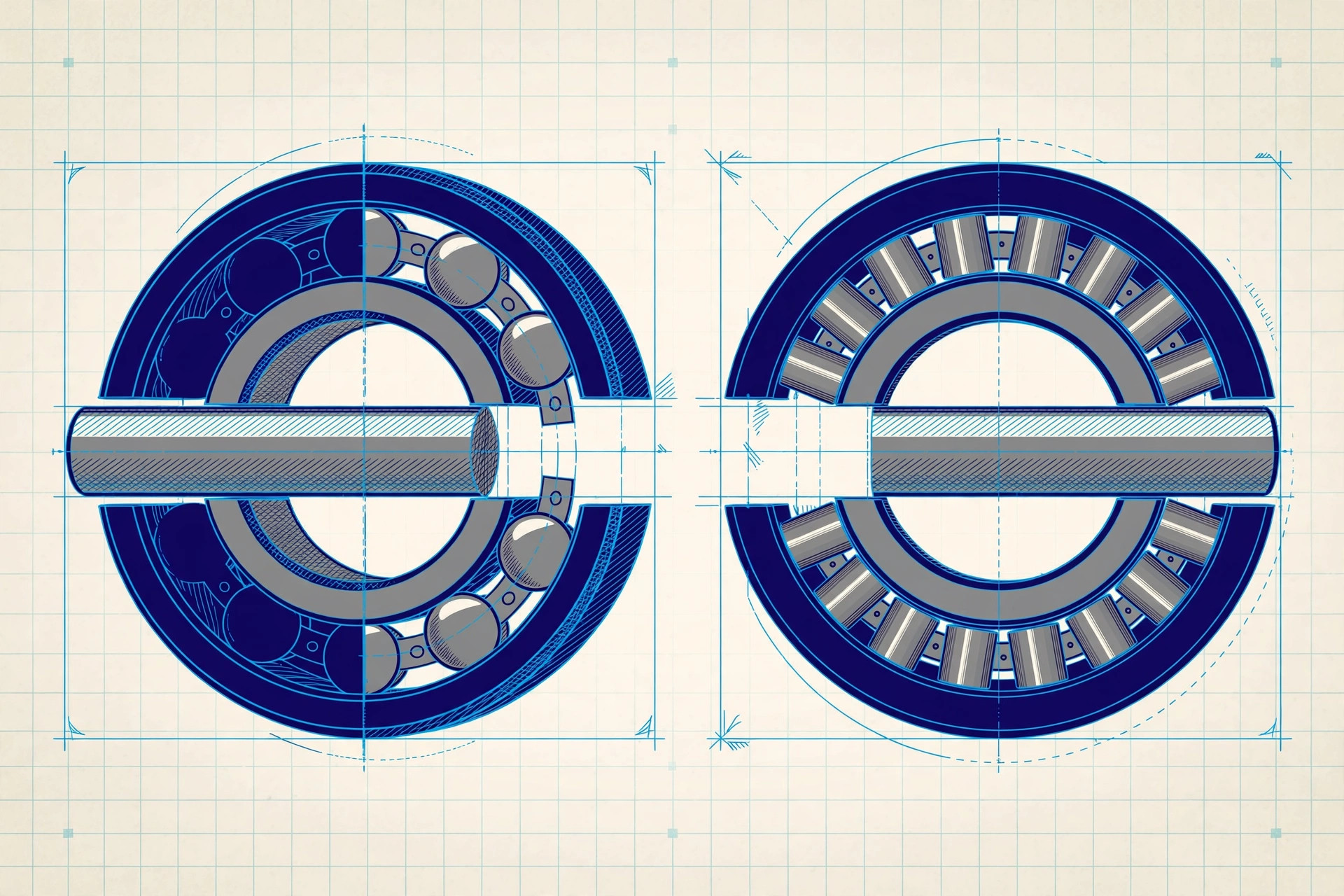
A bearing supports a shaft while letting it turn with minimal friction. Rolling bearings interpose balls or rollers between the shaft and the housing, replacing sliding friction with rolling contact. The common types divide by load direction and shape. Deep groove ball bearings are the general purpose default, taking radial load and moderate axial load both ways. Cylindrical rollers carry heavier radial loads. Tapered rollers take combined loads and appear in wheel hubs and gearboxes, usually in opposed pairs. Angular contact ball bearings serve machine tool spindles. Needle rollers fit where radial space is tight. Spherical rollers forgive misalignment. Choosing begins with the load: its size, direction, and whether shock is present, then speed, space and the life required.
Life, load and the L10 rating
Bearing catalogues rate life by the L10 convention: the number of revolutions, or hours at a stated speed, that 90 percent of a batch of bearings will survive before fatigue spalling appears on a raceway. Life varies with the inverse cube of load for ball bearings, and the 10/3 power for rollers, so doubling the load cuts ball bearing life to an eighth. This steep law makes accurate load estimation the whole game, and explains why a modest overload, or a belt drive tensioned by enthusiasm rather than by gauge, quietly destroys bearings. The rating assumes good lubrication, clean conditions and correct mounting. It is a statistical fatigue life, not a promise: some bearings in the batch fail earlier, which safety critical designs allow for by using L1 or lower percentiles.
Why bearings actually die
In service, pure fatigue is a minority cause of bearing failure. Surveys of failed bearings consistently blame poor lubrication first, then contamination, then bad mounting: hammer blows through the rolling elements, misalignment, and fits that are too tight or too loose. A bearing starved of lubricant or fed grit wears in thousands of hours what fatigue would take millions to do. The practical defences are unglamorous: keep seals intact, store bearings in their wrapping until fitting, press on the correct ring, never through the balls, fill grease to the makers stated fraction, and relubricate on schedule with the specified grease. When a bearing fails, read it before binning it: the damage pattern, flaking, smearing, discoloration from heat, corrosion fretting, usually names the cause, and replacing the bearing without fixing the cause just starts the same clock again.