Belt Drives and Pulleys Explained
Friction does the work
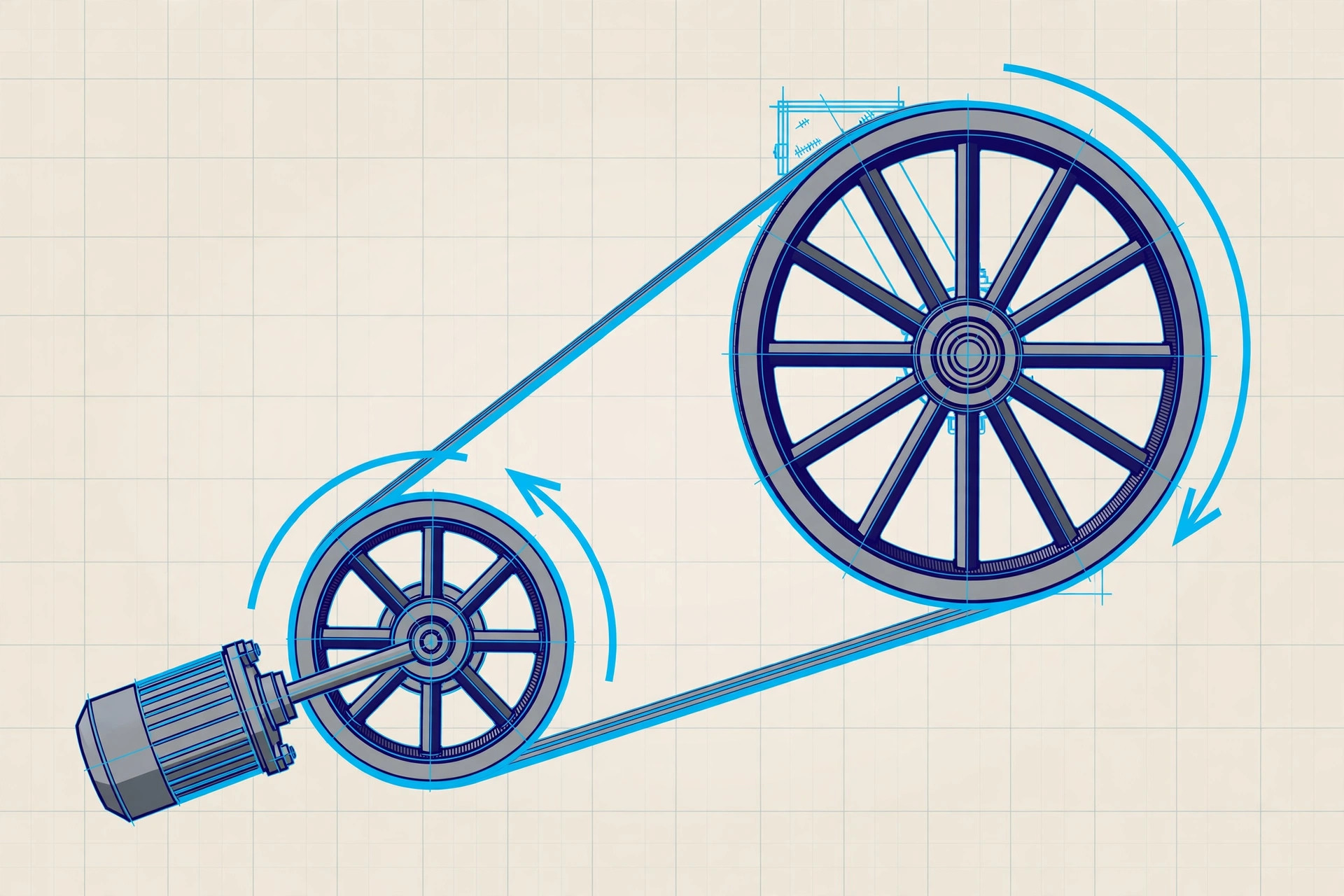
A belt drive transmits power by friction between the belt and the pulley faces, helped in V belts by wedging into the groove, which multiplies the grip. The ratio is set by the pulley diameters: the driven speed is the driver speed times the driver diameter over the driven diameter. Unlike gears, the ratio is approximate, because the belt creeps and slips a percent or two under load. Belt speed matters in its own right: too slow and the required tension grows for a given power, too fast and centrifugal effects lift the belt off the pulley and wear climbs. Most industrial V belt drives live happily between 20 and 30 metres per second. Synchronous toothed belts remove the slip entirely and are chosen when timing must be kept.
Belt length and centre distance
The belt length for an open drive follows from the geometry: twice the centre distance, plus half the sum of the pulley circumferences, plus a small correction for the difference in diameters. The gear geometry of the layout means the designer usually works the other way: pick a standard belt length from the catalogue, then set the centre distance to suit, with adjustment travel for fitting and tensioning. Crossed belts, which reverse the direction, are longer and rub at the crossing, and are mostly a historical curiosity now. The wrap angle on the smaller pulley deserves a look: with a big ratio and a short centre distance the small pulley may have less than 120 degrees of wrap, and grip, not belt strength, becomes the limit.
Belts versus chains, honestly
Belts are quiet, cheap, need no lubrication, absorb shock, and slip harmlessly under a jam, which can protect the rest of the machine. They dislike oil, heat and very high torques, stretch a little over life, and their ratio wanders. Chains give an exact ratio, handle high torque in a narrow width, and tolerate heat and oil, but they need lubrication, make noise, wear their sprockets, and transmit every shock faithfully. The choice follows the duty: conveyors, fans and agricultural machines favour belts; motorcycle final drives, timing drives and heavy slow machinery favour chains. Where both appear in one machine, each is usually doing the job the physics suits it for, and the engineer who swaps them casually learns the differences the expensive way.