Bernoullis Principle Explained
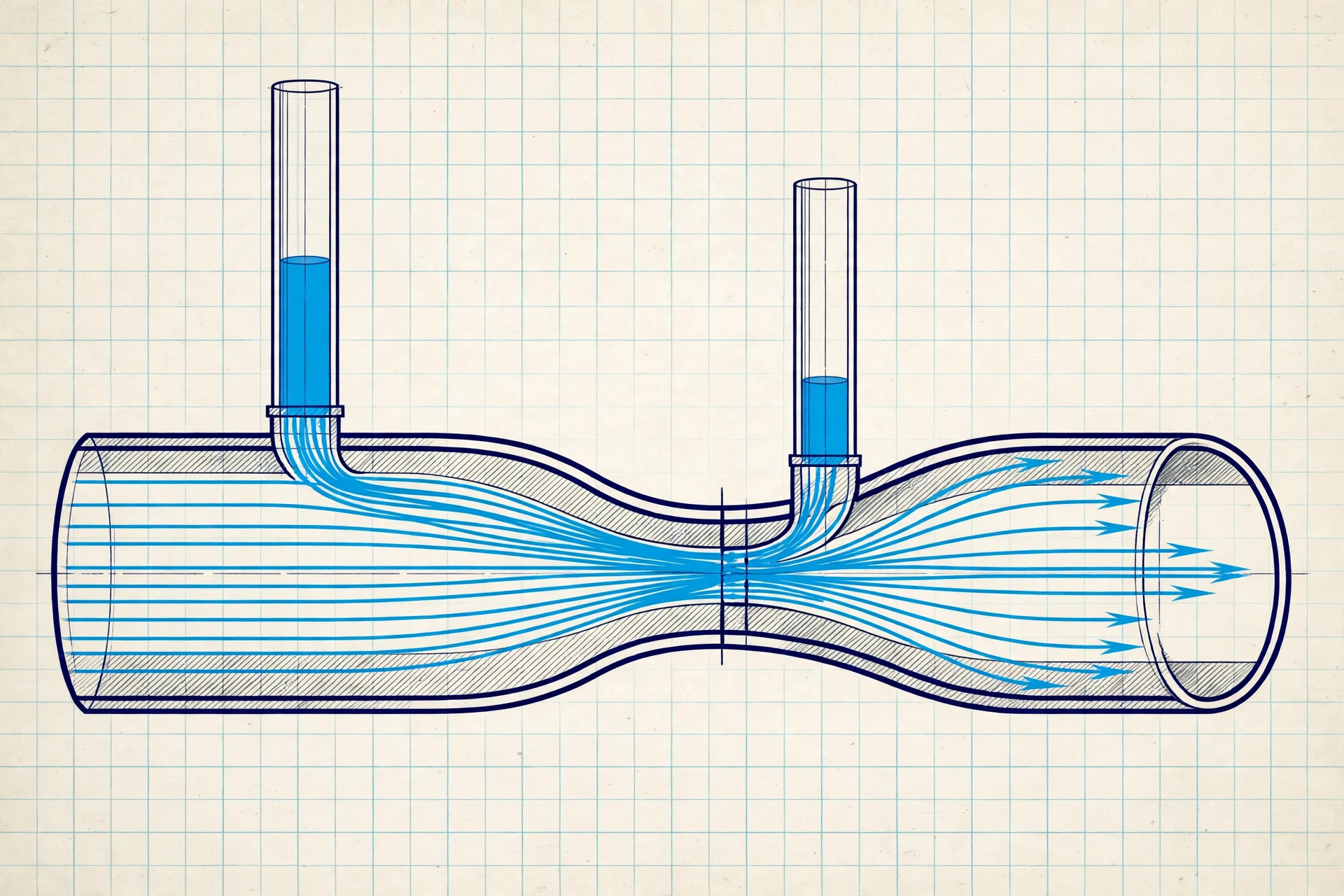
Energy keeping accounts
Bernoullis principle is bookkeeping. Along a streamline in steady flow, the energy of each kilogram of fluid stays constant, held in three accounts: pressure, speed and height. Speed the fluid up and one of the other accounts must pay, usually pressure. Slow it down and pressure recovers. The equation that carries Daniel Bernoullis name from 1738 simply writes the three terms in pressure units: pressure, plus density times g times height, plus half density times velocity squared, is constant along the streamline. The venturi meter exploits it directly: squeeze the flow through a throat, the speed rises, the pressure falls by a measurable amount, and the flow rate follows from the difference.
What it explains well
The principle makes sense of a shelf of everyday effects. It is why a shower curtain billows inward toward the fast moving air and water, why a spinning ball curves as the flow speeds differ around it, why carburettors draw fuel into a fast airstream, and part of why a wing lifts, though the full story of lift needs circulation and downwash as well. In engineering it underlies pitot tubes that measure aircraft speed from pressure difference, orifice and venturi flow meters, ejectors and the suction of a well designed chimney. In every case the honest use is comparative: between two points on the same streamline, with the same fluid, at the same time.
The fine print
The equation rests on assumptions that real systems break casually. It presumes steady flow, an incompressible fluid, no friction along the path, and points on the same streamline. Friction is the big one: a real pipe run loses total pressure continuously, so applying Bernoulli between the ends of a long pipe without a loss term gives confident nonsense. Gases at speeds above about a third of the speed of sound compress enough to need the compressible form. Pumps add energy and turbines remove it, and each must be entered into the account as a term. Used within its limits, Bernoulli is exact and powerful. Used as a magic phrase that pressure always falls where speed rises, without checking the streamline or the losses, it misleads. The pipe flow tools on this site use the friction based equations where friction is the story, which in most pipework it is.