Cavitation Explained: The Pump Killer
Boiling without heat
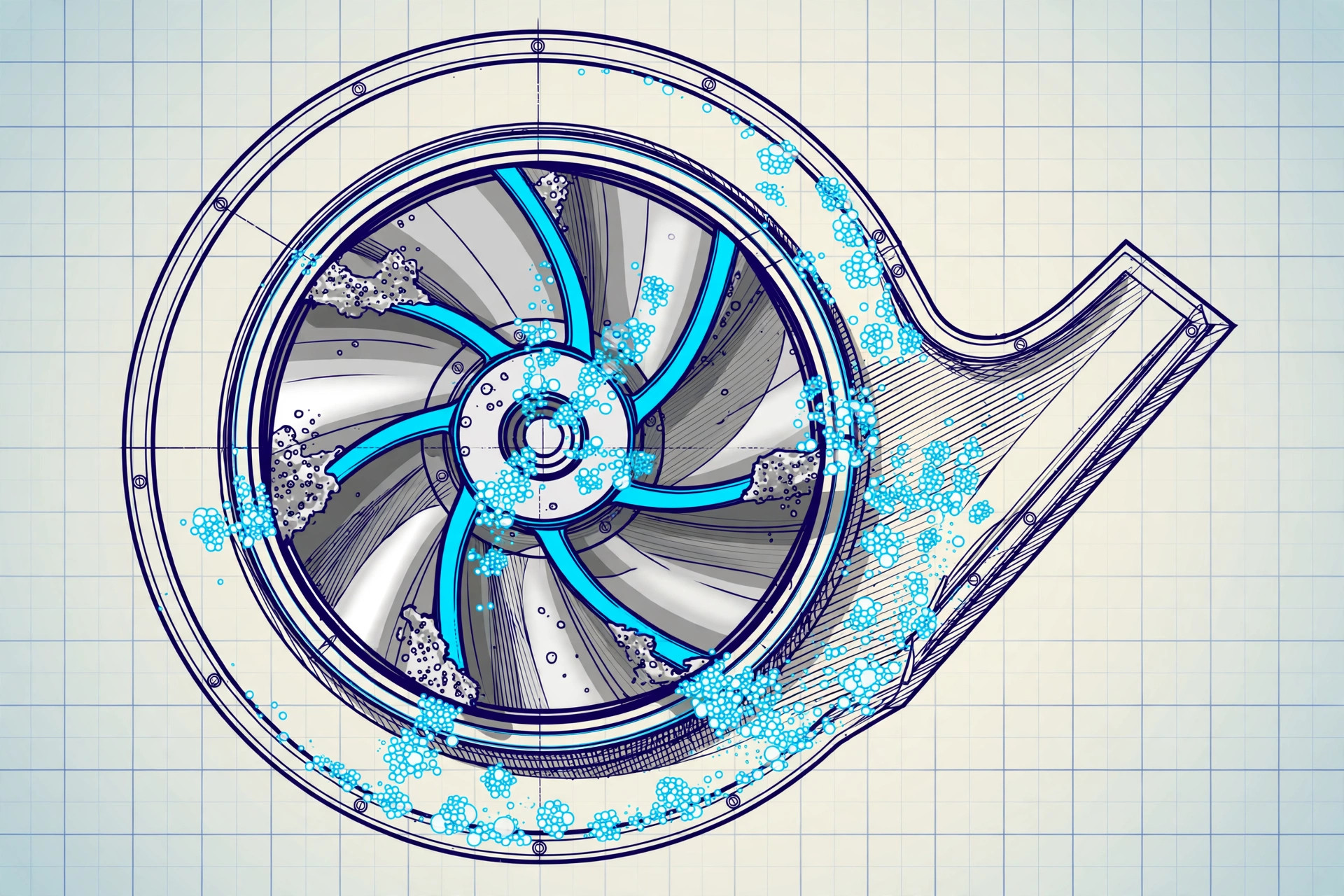
A liquid boils when its pressure falls to its vapour pressure, and that can happen cold. Where flow accelerates into the eye of a pump impeller, the local pressure dips. If it dips to vapour pressure, pockets of vapour form in the liquid. Carried into the rising pressure further around the impeller, those pockets do not gently condense: they collapse violently, in microseconds, focusing the energy into microscopic jets and shocks that hammer the metal surface. Repeated millions of times, the hammering pits and eats the impeller, a damage pattern like coarse spongework, while the pump rattles as if pumping gravel, vibrates, and loses head and efficiency. That whole sequence is cavitation.
NPSH: the margin that matters
Prevention is about keeping the inlet pressure safely above vapour pressure, and the industry packages this as NPSH, net positive suction head. NPSH available is a property of the installation: the pressure at the pump inlet, above vapour pressure, expressed in metres, after the suction pipe losses are paid. NPSH required is a property of the pump, measured by its maker, and rises steeply with flow. The installation figure must exceed the pumps figure by a margin, commonly half a metre to a metre or a ratio of 1.1 to 1.35. Anything that lowers the available side invites trouble: a clogged strainer, a long or thin suction line, pumping hot liquid whose vapour pressure is high, drawing from a vessel under vacuum, or siting the pump higher above the liquid than the design allowed.
Symptoms and cures
The field signs are a crackling noise, vibration, fluctuating discharge pressure, and, on strip down, the characteristic pitted impeller, worst near the inlet edges. Cure follows cause: slow the pump or throttle the discharge to bring the flow back, never throttle the suction, which makes it worse. Enlarge or shorten the suction line, clean the strainer, lower the pump relative to the liquid, cool the liquid or raise the level in the suction vessel. Some damage that looks like cavitation is actually air being drawn in through a leaking suction joint, which gives similar noise with a sound impeller, so check for air first. The deeper lesson is that suction conditions are designed, not inherited: a pump moved to a new duty, a new fluid or a hotter process must have its NPSH sums done again.