Efficiency and Power Losses in Drives
Every element takes its cut
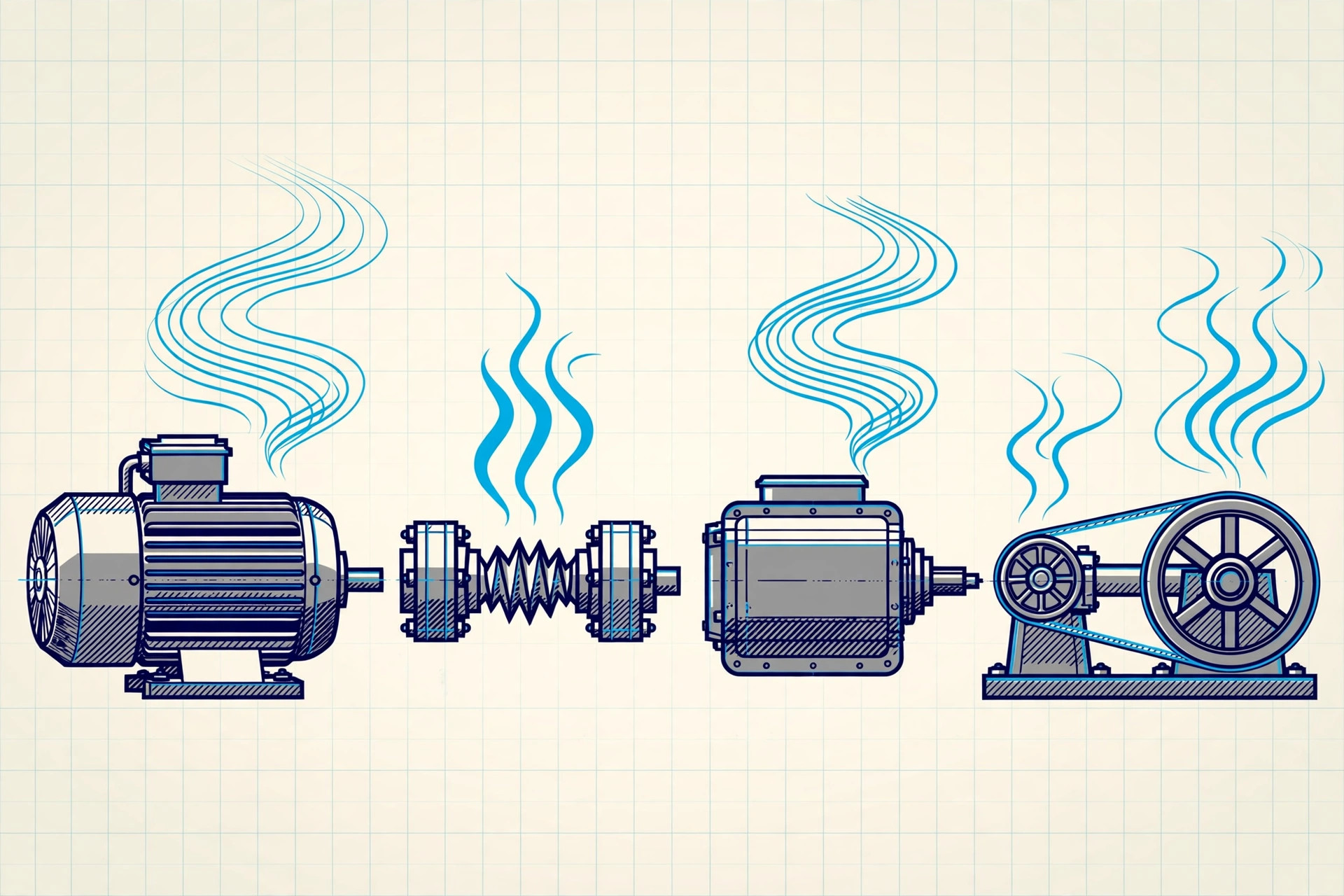
No transmission is free. Each gear mesh, belt, bearing, seal and coupling converts a slice of the passing power into heat, noise and vibration. Efficiency states the fraction that survives one element: 0.98 for a good spur gear mesh, 0.95 for a V belt drive in good order, 0.99 for a rolling bearing, and as low as 0.5 to 0.7 for a single start worm gear, whose sliding contact is inherently wasteful. Losses compound multiplicatively, not additively. A drive train of motor, coupling, two gear stages and a belt, each individually respectable, can easily deliver only 85 percent of the input power to the load. The missing 15 percent leaves as heat, which the gearbox oil and housing must shed, setting a thermal limit that sometimes governs before tooth strength does.
Why efficiency varies
Efficiency is not a fixed property of a component; it depends on load, speed and condition. Gear losses split into load dependent parts, tooth friction and bearing losses that scale with transmitted force, and load independent parts, oil churning and windage that continue even at no load. A gearbox at a tenth of its rated load can show poor efficiency because the churning losses barely fall while the useful output does. Belt efficiency drops with slip from worn or slack belts. Chain efficiency falls sharply when lubrication fails. Temperature matters too: cold thick oil can double churning losses on a winter morning. Catalogue efficiencies are quoted at rated conditions, and honest design uses lower figures for part load, poor maintenance or dirty environments.
Working with losses in practice
Size from the load backwards. Start with the power the load truly needs, divide by the efficiency of each element between load and motor, and the result is the motor power required; then choose the next standard motor size up. When checking an existing installation, measure at one shaft and be careful which side of each element the measurement belongs to. Energy cost sharpens attention: a 100 kW drive running 6000 hours a year at 85 rather than 92 percent efficiency wastes about 45,000 kWh annually, which is why high efficiency motors and drives repay their premium in continuous duty. Finally, treat suspiciously round efficiency claims with care. A seller quoting 99 percent for a complete drive train is describing the best component, not the system.