Euler Buckling, Explained Simply
A different kind of failure
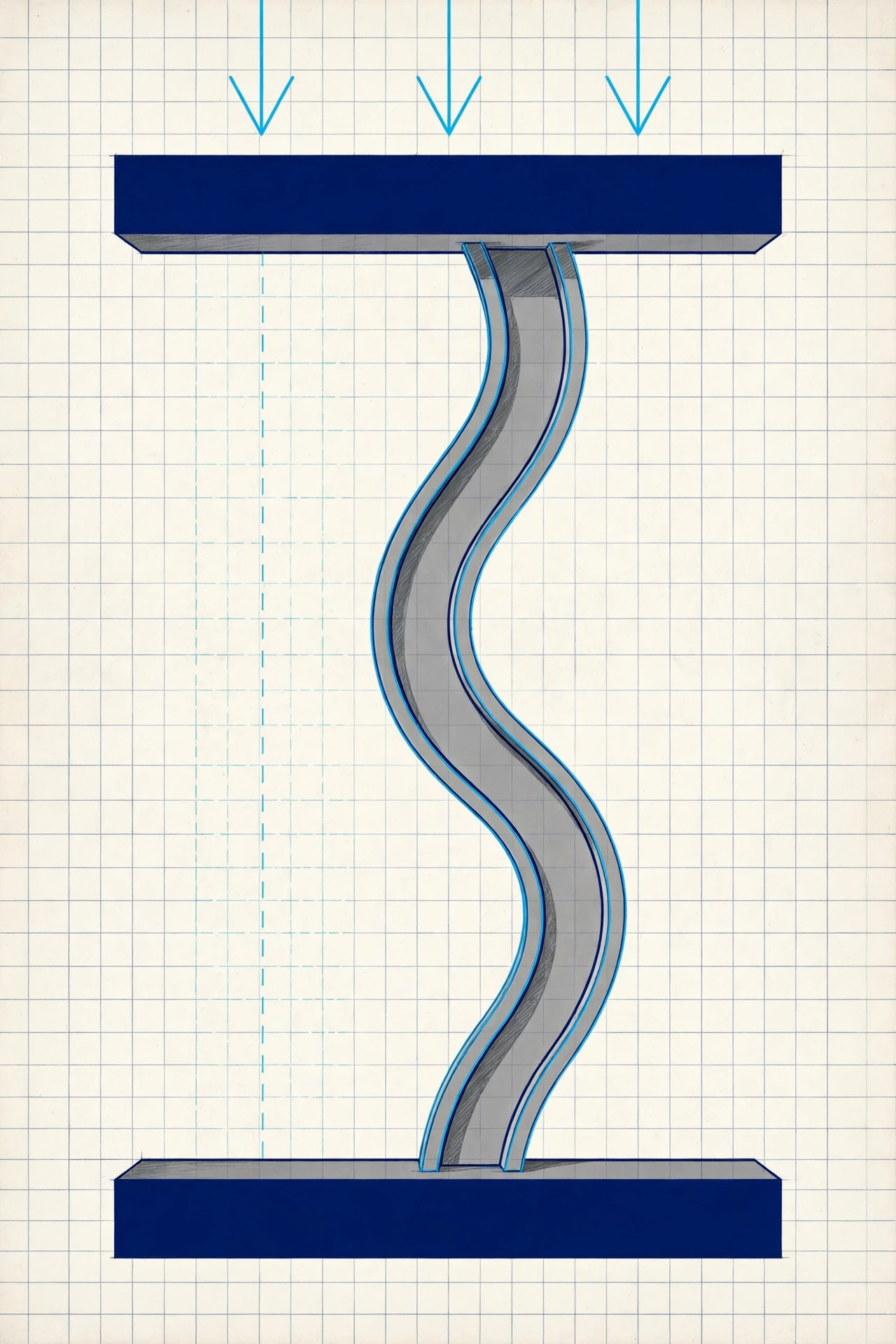
Push down on a short, fat block of steel and it squashes, failing only when the stress reaches the crushing strength of the material. Push on a long thin ruler and something else happens: at a modest load it suddenly bows sideways and collapses, while the average stress in it is still far below anything alarming. That sideways collapse is buckling, and it is a failure of stability, not of material strength. It is sudden, it gives little warning, and it governed some famous structural failures. The longer and thinner the column, the lower the buckling load, which is why slenderness, the ratio of effective length to radius of gyration, is the first number an engineer checks for any strut or column.
What the Euler formula says
In the 1750s Leonhard Euler showed that the critical load is pi squared times E times I, divided by the square of the effective length. Every term teaches something. The load rises with material stiffness and with the second moment of area, so a tube beats a solid bar of the same weight because its material sits far from the centre. The load falls with the square of the length, so doubling a column quarters its capacity. The effective length folds in the end fixings through the factor K: a column pinned at both ends has K of 1, fixing both ends properly can halve the effective length and quadruple the load, while a flagpole arrangement fixed at the base and free at the top doubles the effective length and quarters it.
When Euler stops applying
Euler assumed a perfectly straight, perfectly elastic column. Real columns have slight bends, loads land slightly off centre, and materials yield. For stocky columns the Euler formula predicts critical stresses above the yield strength, which is impossible: the material gives way first. Design codes therefore blend the Euler curve for slender columns with empirical curves, such as the Johnson parabola or the Perry Robertson formulas, for intermediate ones. A practical reading of a result is this: if the Euler critical stress is well below the yield strength, buckling governs and the formula is trustworthy. If it lands near or above yield, treat the column as intermediate, use your code curve, and expect a lower capacity than Euler suggests.