Fatigue and the Endurance Limit
Failure by repetition
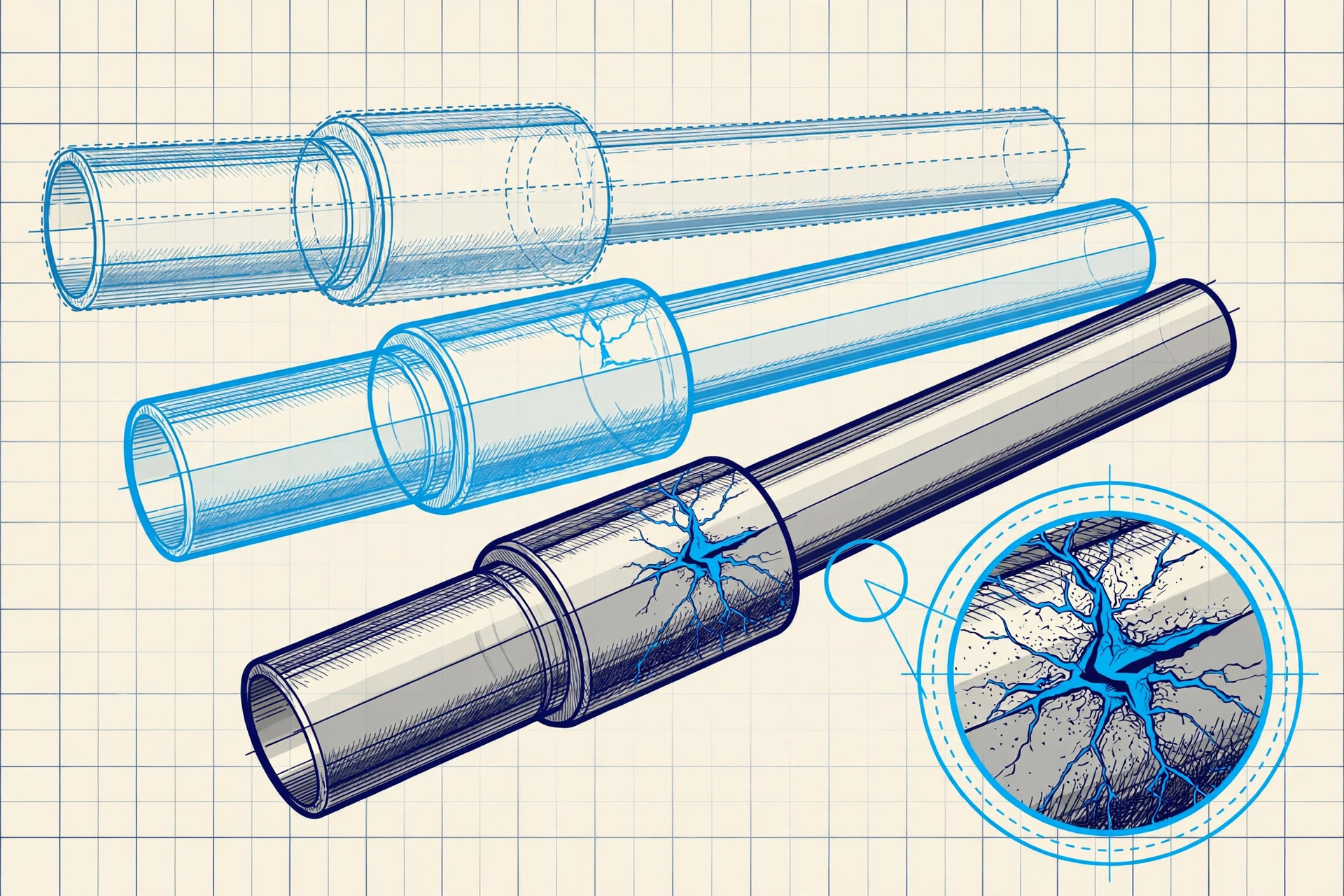
A part can survive a load once and fail under the same load repeated a million times. Each cycle grows a microscopic crack a little, usually starting at a surface defect, a sharp corner or a corrosion pit, until the remaining section can no longer carry the load and it parts suddenly. The broken faces tell the story: a smooth, beach marked region where the crack crept, and a rough final zone where it tore. Rotating shafts are the classic victims because every revolution cycles each surface fibre from tension to compression and back. The railway axles of the 1840s failed this way in service, and the investigations that followed founded the whole science of fatigue.
The S N curve and the endurance limit
Fatigue testing plots stress range against the number of cycles to failure, giving the S N curve. For many steels the curve flattens at a stress below which life is effectively unlimited: the endurance limit, roughly half the ultimate tensile strength for polished specimens. Aluminium alloys have no true limit; their curves keep falling, so designers work to a fatigue strength at a stated life such as a hundred million cycles. Real parts fall short of the polished specimen figures. Surface finish, size, corrosion, temperature and stress concentrations all knock the value down, and the modifiers can easily halve it. A scratched, corroded shaft in bending may have an honest endurance limit of only a fifth of the tensile strength.
Designing against fatigue
The practical rules are well proven. Keep cyclic stresses below the endurance limit where unlimited life is needed, or design explicitly for a counted life where it is not. Kill stress concentrations: generous fillet radii, smooth transitions, no sharp keyway corners in highly stressed zones, and threads rolled rather than cut where possible. Protect the surface, since cracks start there: polishing, shot peening, which leaves the surface in protective compression, and coatings against corrosion all pay. Inspect where failure would matter, using dye penetrant or magnetic methods to catch cracks early. Above all, remember that a static calculation passing with a fine margin says nothing about fatigue. Any part that sees repeated load needs the fatigue question asked separately.