Fits and Tolerances Explained
Exact sizes do not exist
No manufacturing process makes a part to an exact dimension. Every real size lands somewhere in a scatter around the target, wider for sawing and casting, narrower for grinding and lapping. Tolerancing is the discipline of stating, on the drawing, the band of sizes that will still work: the limits within which the part is accepted. A dimension of 25 mm with limits 24.98 and 25.02 accepts anything in that window and rejects the rest. The tolerance, the width of the window, is a cost decision as much as a technical one, because halving a tolerance typically adds a process step: turn it, then grind it, then lap it, each stage slower and dearer than the last.
Fits: clearance, transition, interference
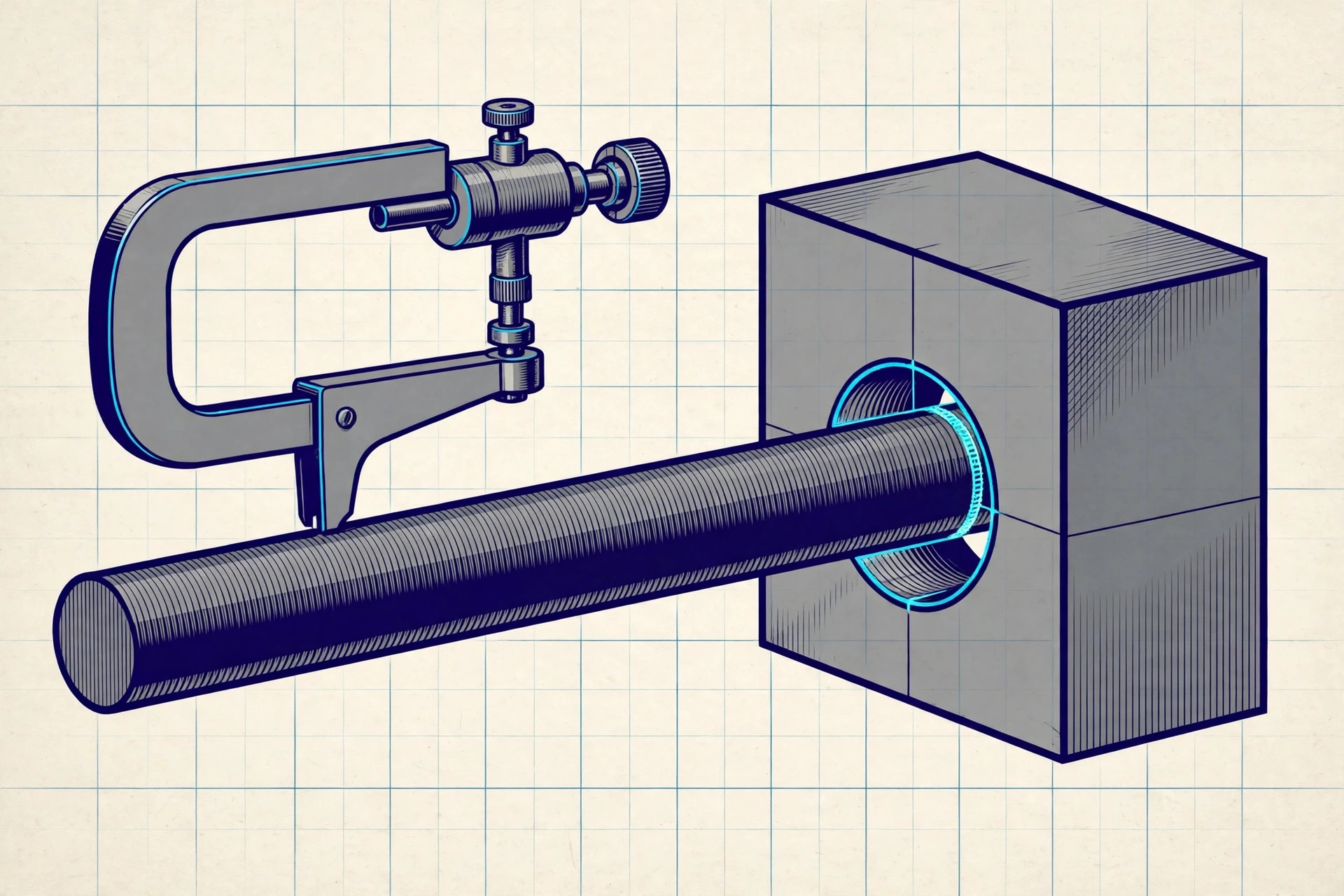
A fit describes what happens when two toleranced parts meet, usually a shaft in a hole. A clearance fit always leaves a gap: the shaft is always smaller than the hole, so the parts slide or rotate freely. An interference fit always overlaps: the shaft is always larger, and the joint is pressed or shrunk together and holds by friction, like a bearing inner ring on a shaft. A transition fit may land either way, giving location with light assembly force. The ISO system names fits by letters and numbers, such as H7 g6: capital letters for the hole, lower case for the shaft, the number for the tolerance grade. H7 g6 is a close sliding fit; H7 p6 is a press fit. The numbers are not arbitrary: they come from standard tables tied to the nominal size.
The hole basis habit
Industry overwhelmingly uses the hole basis system, in which the holes minimum size is the nominal size, the H hole, and the fit is adjusted by choosing the shaft tolerance. The reason is tooling: holes are made with drills and reamers of fixed size, while a shaft can be turned or ground to any size cheaply. So a workshop stocks H7 reamers and varies the shaft. Specifying fits well means thinking about the job the joint does: a gearbox bearing seat, a locating dowel, a sliding gear and a shrink fitted coupling all want different fits, and the same nominal diameter can honestly carry any of them. The costly mistakes are specifying a precision fit where a loose one works, which buys nothing, and a loose one where location matters, which no adjustment later can cure.