How Beam Deflection Works
Why beams bend at all
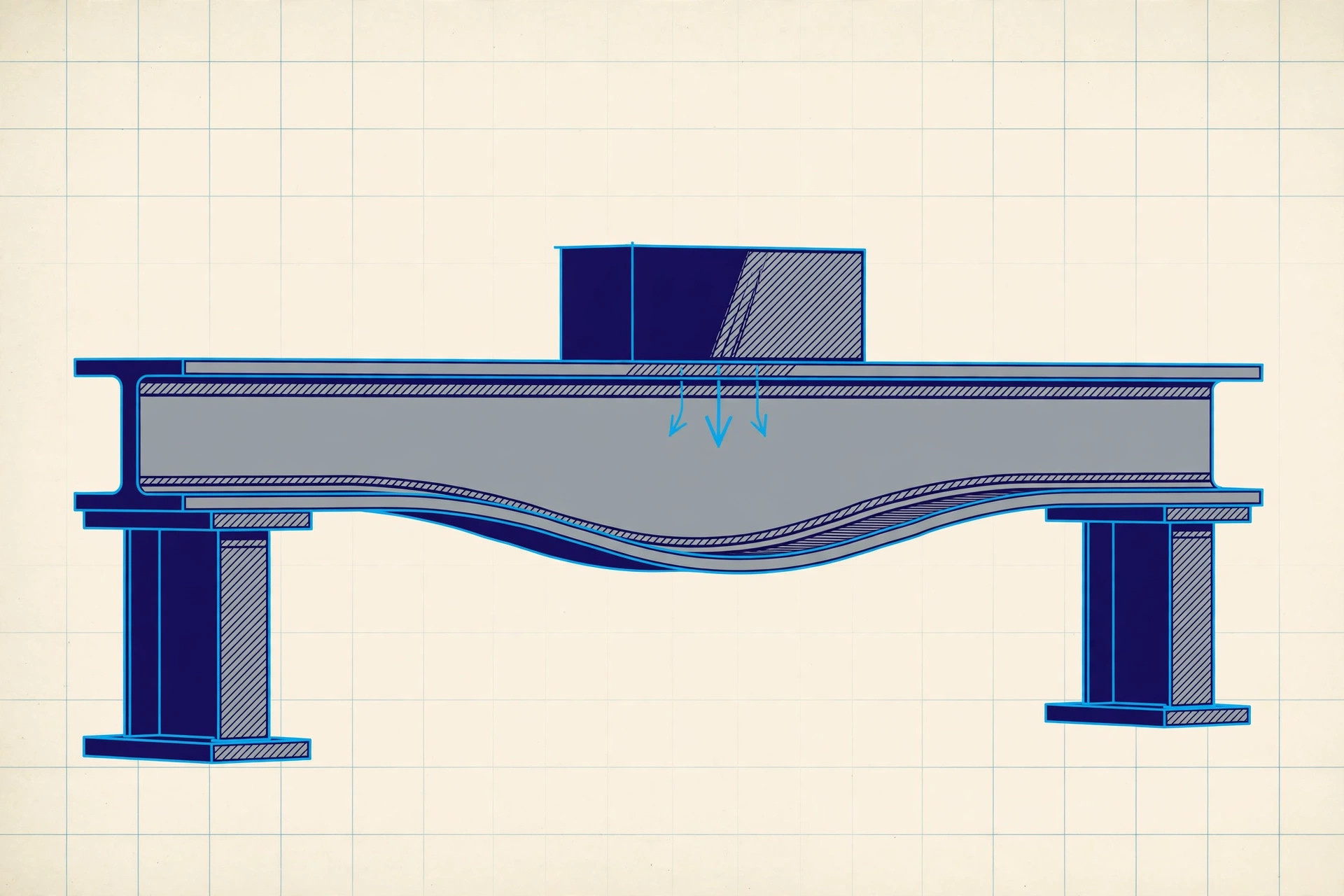
No material is perfectly rigid. When a load presses on a beam, the top fibres shorten a little and the bottom fibres stretch a little, and the beam curves. That curve is deflection. A floor beam can be strong enough not to break yet still bend enough to crack ceiling plaster, make doors stick and feel bouncy underfoot. That is why engineers check deflection separately from strength, and why building codes set limits such as span divided by 250 or 360. The amount of bend depends on four things: the size of the load, the length of the span, the stiffness of the material, and the shape of the cross section. Of these, span is the bully: doubling the span of a beam under a central point load multiplies the deflection eight times.
Stiffness: E and I working together
Two properties decide how much a given beam resists bending. The first is Youngs modulus, written E, a property of the material itself. Steel sits near 200 GPa, aluminium near 69, and timber between roughly 8 and 14 depending on species and grade. The second is the second moment of area, written I, a property of the cross section shape. Deep sections are dramatically stiffer than shallow ones: doubling the depth of a rectangular beam multiplies I by eight, because depth enters the formula cubed. This is why floor joists and I beams are tall and thin rather than short and fat. E and I always appear multiplied together in deflection formulas, a product engineers call the flexural rigidity. A stiff beam is one with a high E, a high I, or both.
Reading a deflection result
The classic formula for a simply supported beam with a load in the middle gives deflection as P times L cubed, divided by 48 times E times I. For a load spread along the beam the 48 becomes a different arrangement with a factor of 5 over 384. Whatever the pattern, compare the answer with the limit that applies to your case, often expressed as a span ratio. A 4 metre floor beam allowed span over 360 may deflect at most about 11 mm under full load. If the calculated value is larger, the fixes in order of power are: shorten the span or add a support, deepen the section, choose a stiffer material, then widen the section. Adding width helps only in direct proportion, while depth helps with the cube, which is why deepening wins.