How Fans and Blowers Work
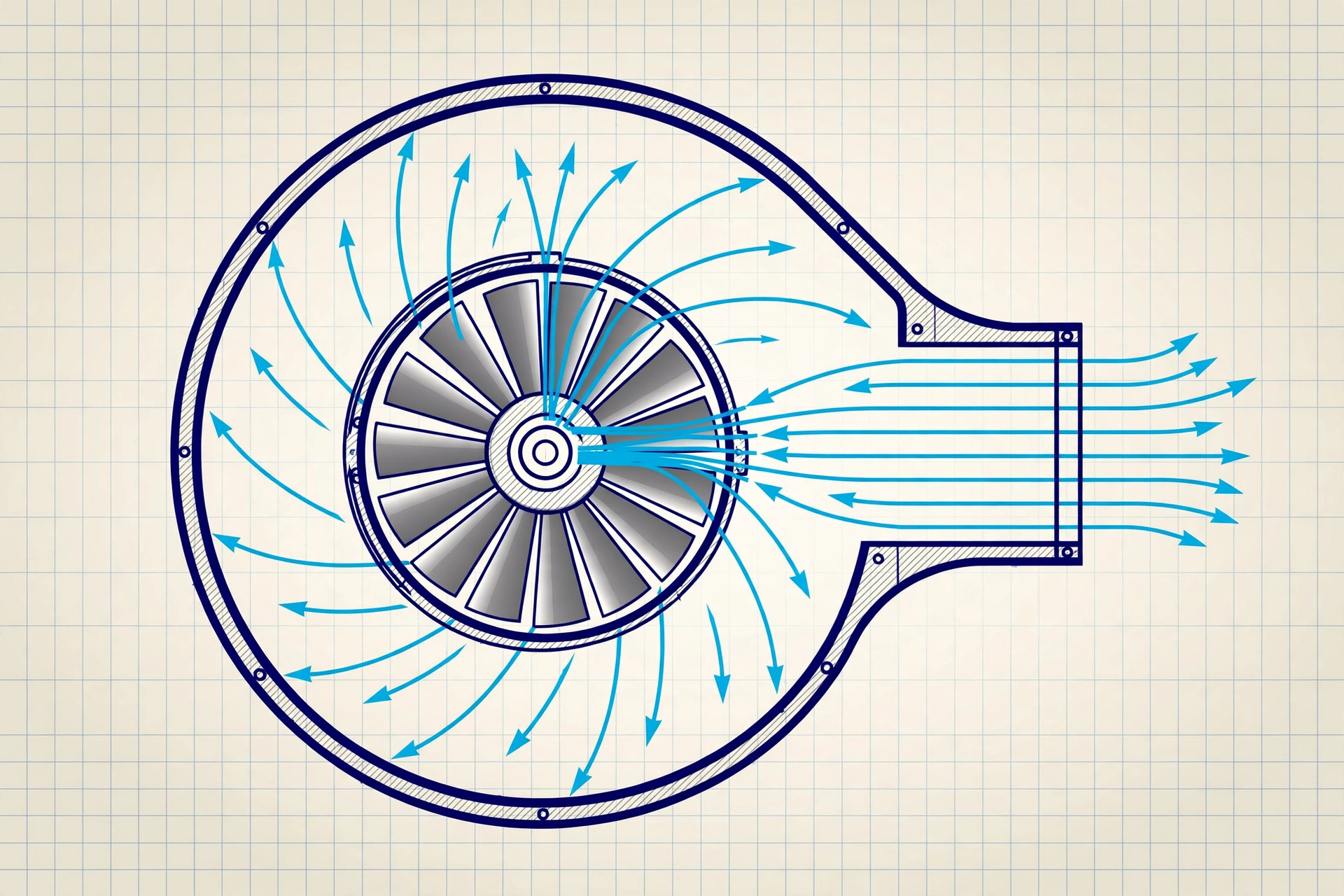
Moving air against resistance
A fan spends power pushing a volume of air against the pressure resistance of ducts, filters, coils and grilles. The air power is simply the volume flow times the pressure rise, and the shaft power divides that by the fan efficiency. Fans are classed by the pressure they can make: fans proper up to a few kilopascals, blowers beyond that, and compressors where density change becomes the story. The fan types divide by their wheel geometry: centrifugal fans, quiet and capable of real pressure, dominate building services and industry; axial fans move large volumes at low pressure, like cooling towers and condenser coils; mixed flow splits the difference. Choosing starts with the duty point, the flow and pressure the system demands simultaneously.
The fan laws
For a given fan and system, three scaling laws follow from the physics and are worth memorising. Flow varies in direct proportion to speed: 10 percent more speed, 10 percent more air. Pressure varies with the square of speed. Power varies with the cube: that same 10 percent speed rise costs 33 percent more power, and conversely, slowing a fan by 20 percent nearly halves its energy. This cube law is why variable speed drives transformed fan energy economics: most systems spend most hours needing less than full flow, and meeting that need by slowing the fan rather than throttling a damper saves the difference between a square law and a cube law. The laws assume the same fan and unchanged system, and they apply point to point along the same system curve.
The fan meets the system
A fan does not choose its flow; the system does. Plot the systems resistance curve, pressure against flow, rising roughly as a square law, over the fans pressure curve at the running speed, and the crossing point is where the installation will actually run. Fit a dirtier filter, close a damper, or add a duct run, and the system curve steepens and the point slides to lower flow, which is why buildings drift out of balance over the years. Run two fans in parallel and their flows add at the same pressure; in series their pressures add, the arrangement for long high resistance paths. When a fan disappoints, measure before blaming: check the rotation, the belt slip, the filter state and the actual speed, because the fan laws mean a small speed shortfall quietly explains a large flow shortfall.