Insulation Materials Compared
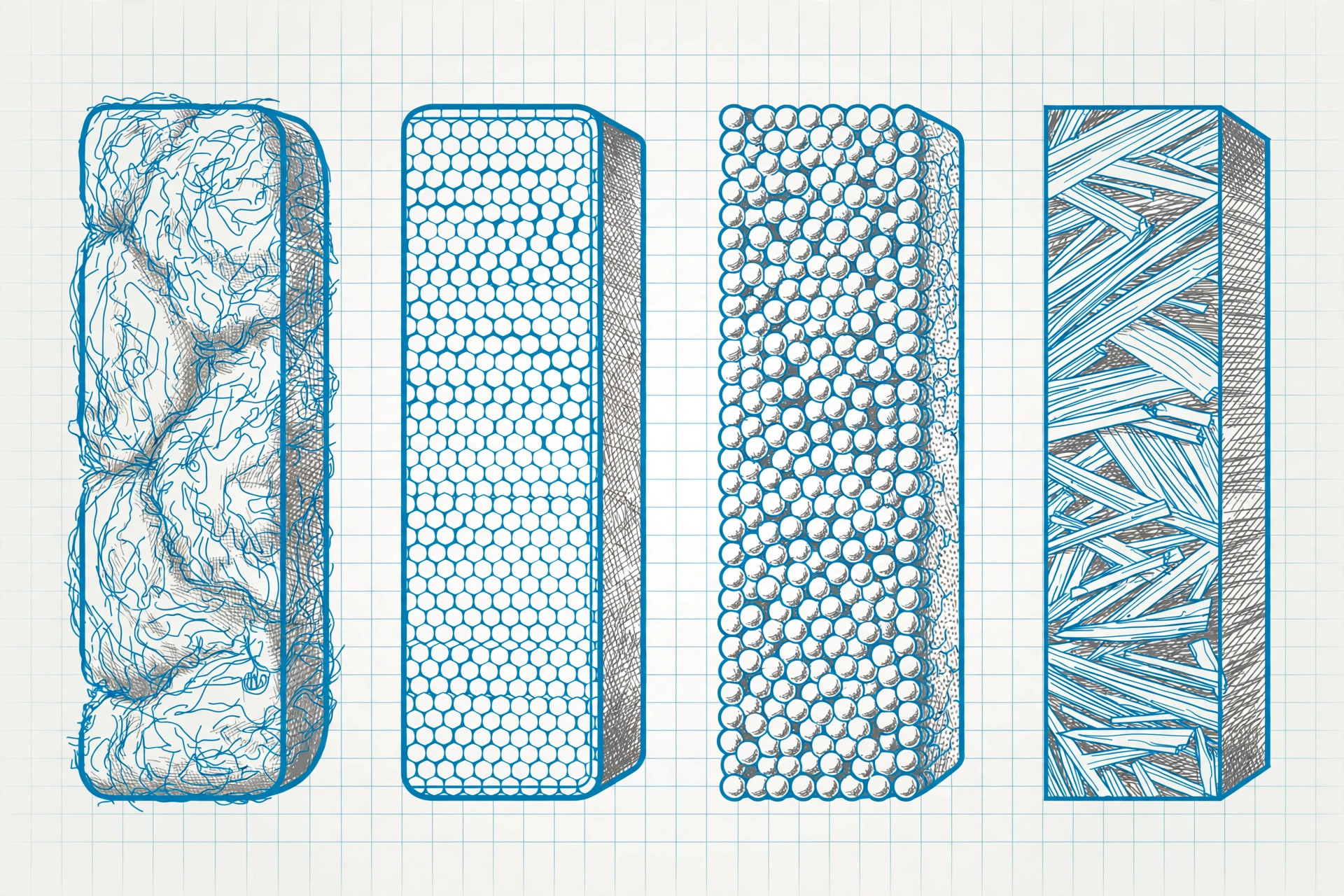
The conductivity league table
Insulation works by trapping still gas in small pockets, so most materials cluster near the conductivity of the gas itself. The best common performers are the rigid foams: PIR and polyurethane boards at about 0.022 watts per metre kelvin, with phenolic foam slightly better still. Expanded and extruded polystyrene follow at 0.030 to 0.038. Mineral wool and glass wool sit near 0.035 to 0.044, a little behind the foams per millimetre but ahead on other counts. Natural options, wood fibre, sheep wool, cellulose and cork, land between 0.038 and 0.05. At the extremes sit the specialists: aerogel blankets near 0.015 and vacuum insulated panels below 0.01, at prices that confine them to where thickness is impossible. The practical meaning: to reach a given resistance, PIR needs roughly half the thickness of mineral wool.
More than a conductivity figure
Choosing on conductivity alone is the beginner error. Mineral wool is non combustible, an excellent sound absorber, vapour open and tolerant of rough cavities it can be friction fitted into; it is the default where fire performance matters. Rigid foams pack more resistance into thin floors and flat roofs but are combustible to varying degrees and need correct covering and detailing. Polystyrene is cheap and moisture tolerant, good under slabs and in render systems. Natural fibres buffer moisture and suit breathable traditional construction, at greater thickness and cost. All insulation fails if installed with gaps, compression or wind washing through it: the as built performance gap between design and reality is mostly workmanship and detailing, not material choice. Airtightness, the unglamorous partner, often matters as much as the insulation itself.
Thickness, targets and diminishing returns
Because resistance adds linearly with thickness while heat loss follows the reciprocal, insulation obeys diminishing returns. The first 50 mm on a bare wall cuts its loss dramatically; each further 50 mm cuts what remains by a smaller absolute amount. Regulations and economics settle at the knee of that curve: wall U values around 0.2 to 0.3 in many climates, roofs lower because roof insulation is cheap to make thick. The wall heat loss calculator on this site lets you test your own build up: enter the layers honestly, including the masonry and plaster, and see which layer is doing the work. Usually one layer dominates the resistance, and improving any other layer first is wasted money, a ranking exercise worth doing before buying anything.