Laminar and Turbulent Flow
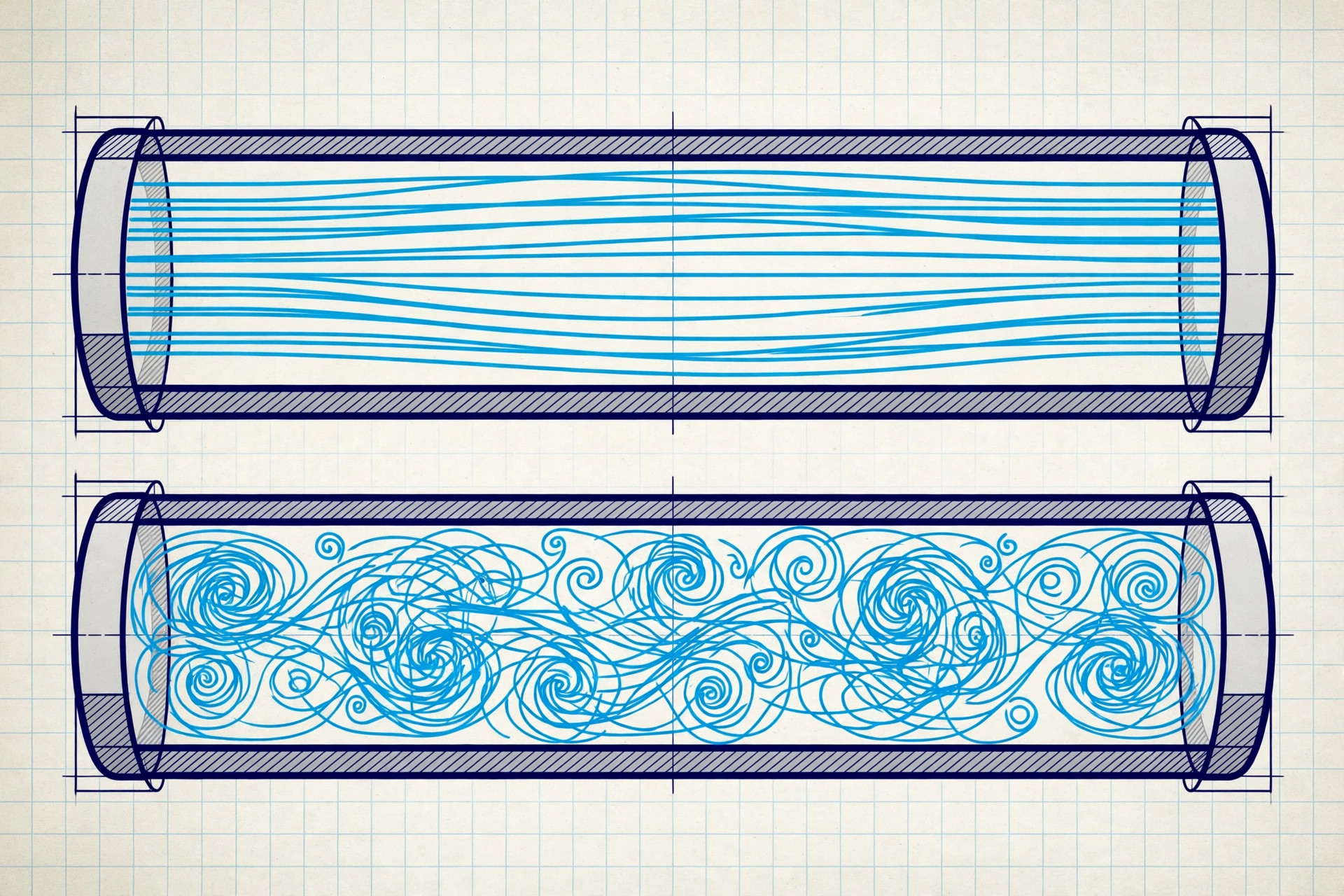
Seeing the difference
In 1883 Osborne Reynolds injected a thread of dye into water flowing through a glass pipe. At low speed the dye ran straight down the middle in a clean line, the layers of water sliding over each other without mixing: laminar flow. As he raised the speed the thread began to waver, then suddenly burst into a cloud that filled the pipe: turbulent flow. The demonstration is still the clearest picture of the two regimes. In laminar flow each particle follows a smooth path, momentum crosses between layers only by molecular viscosity, and in a pipe the velocity profile is a parabola with the centre moving at twice the average speed. In turbulent flow eddies stir everything, the profile flattens, and the centre moves at only about 1.2 times the average.
Friction and mixing consequences
The regimes cost differently. Laminar friction is orderly and exactly predictable: the friction factor is 64 over the Reynolds number, and pressure drop grows in direct proportion to velocity. Turbulent friction is higher and grows roughly with velocity to the power 1.75 to 2, which is why pumping costs climb so fast when systems are pushed. But turbulence is not simply bad. Its mixing transfers heat superbly, which is why heat exchangers are designed to stay turbulent, and it keeps particles in suspension and chemicals blended. Laminar flow, for its part, is what blood vessels, oil lines and microfluidic devices rely on, and its predictability makes it the regime of precision dosing and quiet hydraulics. The transition between them, around Reynolds 2300 to 4000 in pipes, is a region designers avoid for duties that must be stable.
Choosing your regime
In most water and air systems of any size, turbulence is unavoidable and welcome. A 100 mm water pipe reaches transition at a velocity of only about 0.03 metres per second; everything practical is far above it. Laminar flow belongs to viscous fluids, small passages and low speeds: honey, lubricating oil films, paint and polymer melts live there, and there the exact laminar formulas give pressure drops that can be enormous because viscosity, not density, runs the show. When you calculate a system, establish the regime first. Using a turbulent friction correlation in laminar flow, or the other way round, is not a small error: it can misstate the pressure drop severalfold, and with it the pump size, the energy bill and the noise the system will make.