Mechanical Advantage Explained
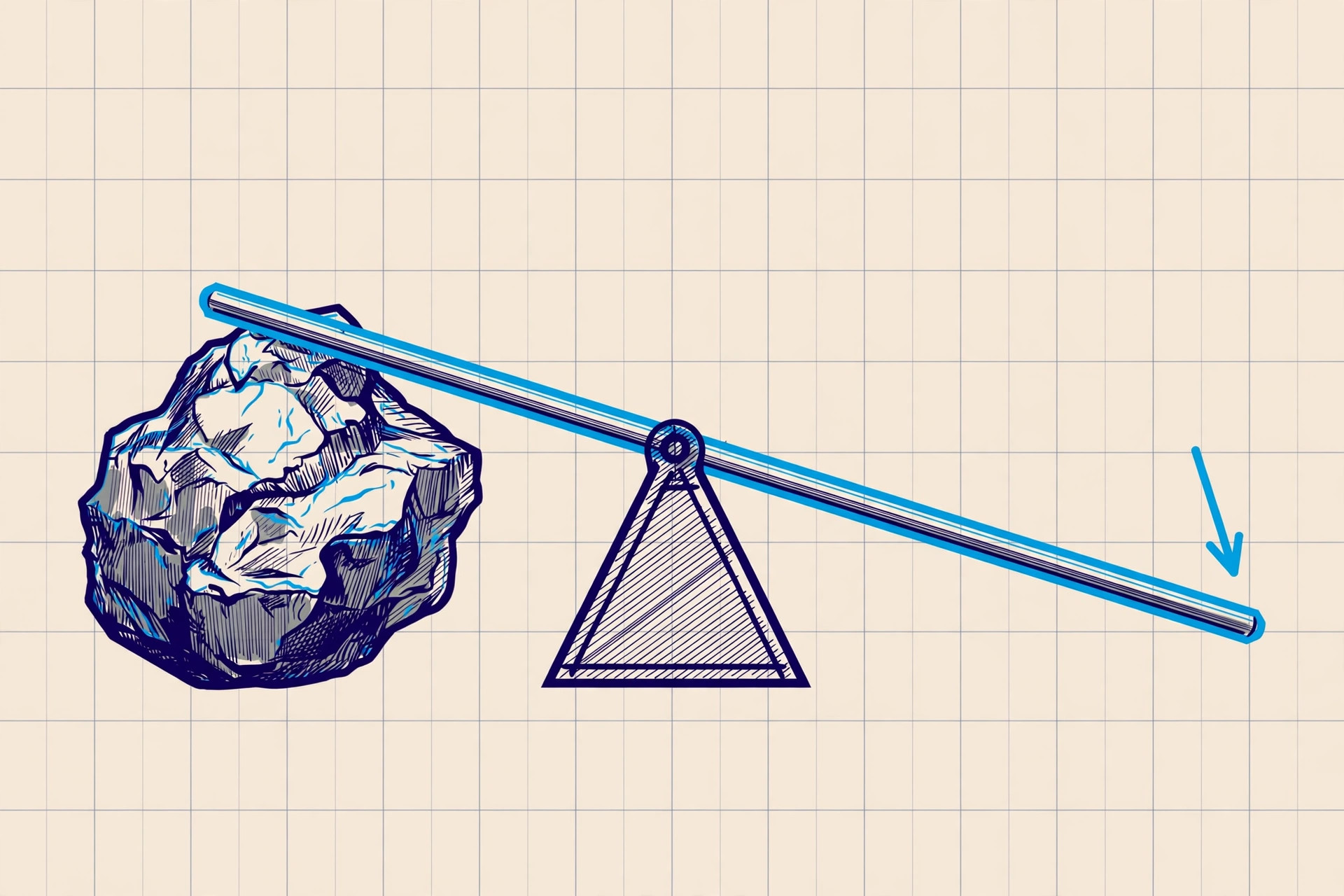
Force bought with distance
Mechanical advantage is the ratio of the force a machine delivers to the force you put in. A lever with the effort arm five times the load arm multiplies force fivefold. The price is paid in movement: the effort end travels five times as far as the load end moves. This exchange, force for distance, is the iron law behind every simple machine. Gears trade torque against speed in exactly the same way, a screw jack trades many turns of a handle for a slow powerful lift, and a block and tackle trades rope pulled for load raised. In each case the product of force and distance, the work, comes out no greater than it went in. Any device claiming otherwise is claiming free energy, and the fault is in the claim, not in physics.
Ideal versus actual advantage
Textbooks compute the ideal mechanical advantage from geometry alone: arm lengths, tooth counts, rope falls, piston areas. Real machines fall short by their efficiency. The actual advantage is the ideal figure times the efficiency, and efficiency varies enormously by device: a good gear pair returns 98 percent, a well kept block and tackle perhaps 80, a screw jack as little as 30 because thread friction devours the rest, though that same friction usefully holds the load when you stop turning. Hydraulic systems play the same game with pressure: a small piston pumped by hand pressurises oil that acts on a large piston, multiplying force by the area ratio while the large piston moves proportionally less. The oil does not create the advantage; the geometry does.
Using advantage deliberately
Good design spends mechanical advantage where it is needed and no more. Excess advantage makes mechanisms slow, bulky and insensitive: a machine that lifts a tonne with a fingertip also gives the operator no feel for the load. Advantage also multiplies the consequences of friction variation, which is why screw driven presses are rated cautiously. The other direction matters too: speed increasing drives, like a bicycle chainring smaller than its sprocket or the step up pulleys on a drill press, trade force away to buy speed, and the same ratio arithmetic describes them with the fraction inverted. When you analyse any unfamiliar machine, trace the path of power from input to output and write the ratio at each stage; the product of the stage ratios, times the efficiencies, tells you the whole truth about the machine.