Power Factor Explained
Real power and the rest
In AC circuits with motors and transformers, the current and voltage fall out of step. Part of the current, in phase with the voltage, does real work and is measured in kilowatts. Another part, a quarter cycle adrift, shuttles energy into magnetic fields and back, doing no net work but occupying cables, transformers and generators all the same; it is measured in kvar. The two combine as the sides of a right triangle into the apparent power in kVA that the supply equipment must actually carry. Power factor is the ratio of real to apparent power, the cosine of the phase angle between voltage and current. A power factor of 1 means every ampere works. A factor of 0.7 means the system carries over 40 percent more current than the work requires.
Why it costs money
The extra current is not free. It heats cables and transformers in proportion to its square, it eats capacity that could serve other loads, and it worsens voltage drop along the run. Utilities therefore meter industrial customers on kVA or charge penalties below an agreed power factor, commonly 0.95. The causes are predictable: induction motors are the main one, especially lightly loaded ones, whose magnetising current is roughly constant while their working current falls with load, so an oversized motor idling along is a power factor disaster. Transformers, welders, discharge lighting and older fluorescent ballasts contribute. Modern variable speed drives present a different distortion based poor factor, which capacitors do not fix and filters address.
Correction: capacitors at the source
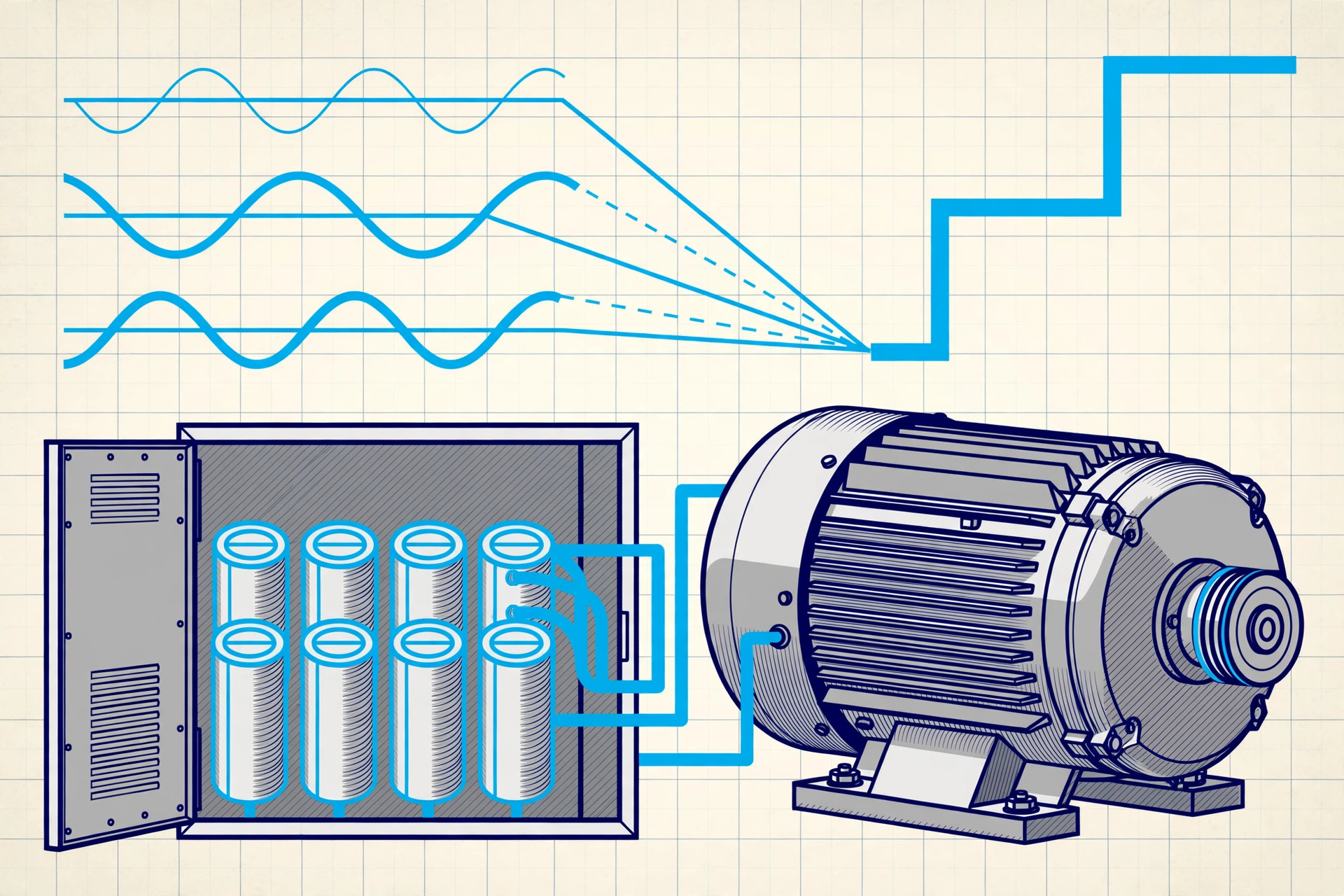
The standard cure is to supply the reactive power locally with capacitors, whose current leads the voltage and cancels the lagging current of the motors. Correction can be fitted at each large motor, in groups, or as an automatic bank at the main intake that switches steps in and out as the load changes. Sizing aims for about 0.95 to 0.98 lagging: pushing to exactly 1 risks overcorrection into leading power factor at light load, which raises voltage and can incur its own penalties. The savings case is usually strong: released transformer capacity, lower losses and avoided penalties commonly repay a bank within a year or two. The three phase calculator on this site shows the kvar in any balanced load, which is the size of the hole the capacitors must fill.