Pressure Drop in Pipes Explained
Pressure is spent, not lost
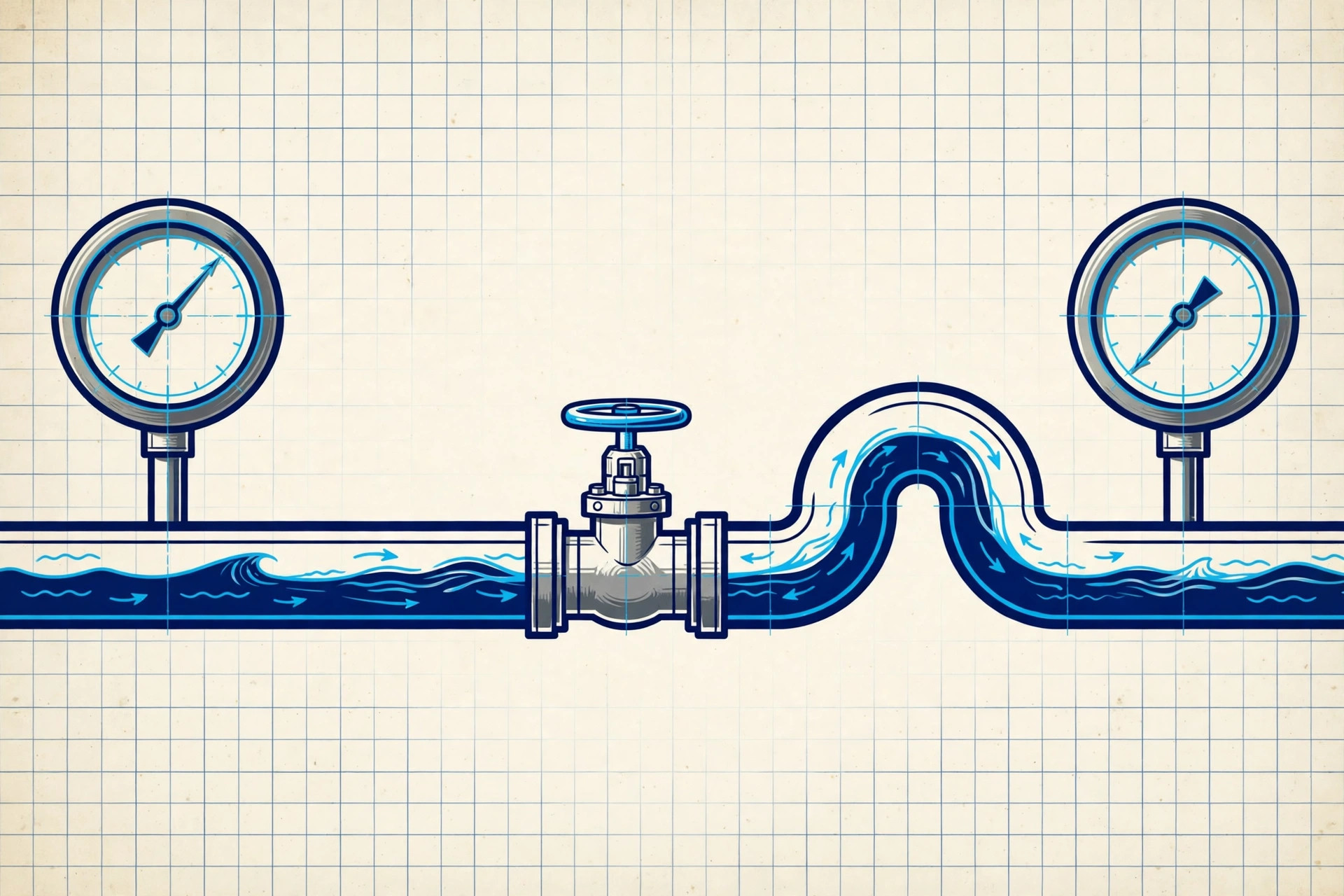
Pressure drop is the price a fluid pays to move. Push water through a pipe and the pressure at the far end is lower than at the pump, spent on three things: rubbing along the pipe walls, tumbling through fittings and valves, and climbing to a higher level. Engineers add the three together to find the system resistance the pump must beat. Only the height part is recoverable in any sense; friction and fittings turn pressure into a whisper of heat. The system curve, pressure drop against flow, rises roughly with the square of flow in turbulent conditions, and the pump settles where its own curve crosses the systems. Everything in pipe design is about predicting that crossing honestly.
The Darcy Weisbach equation
The workhorse formula multiplies the friction factor by the length to diameter ratio and by the dynamic pressure, density times velocity squared over 2. Each term carries a lesson. Length over diameter says long thin pipes are expensive: halving a pipes diameter at the same flow raises its velocity fourfold and its length ratio twofold, multiplying the drop about thirty twofold, the single most violent sensitivity in the subject. Velocity squared says modest flow increases cost dearly. The friction factor, from the Moody chart, depends on Reynolds number and the relative roughness of the wall: around 0.02 for smooth commercial pipe in full turbulence, higher for corroded or scaled pipe, and exactly 64 over Reynolds number in laminar flow, where roughness ceases to matter.
Fittings, valves and honest totals
Bends, tees, valves and entrances each disturb the flow and charge for it, charged either as a loss coefficient K times the dynamic pressure, or as an equivalent length of straight pipe added to the run. A fully open gate valve costs little; a globe valve, with its tortured path, can cost as much as hundreds of diameters of pipe, and a partly closed valve costs whatever it likes, which is the point of it. Strainers and filters grow more expensive as they clog, a drop that rises over the maintenance cycle. The common estimating errors are ignoring fittings on short runs, where they dominate, using the nominal rather than the actual bore, and forgetting that the friction factor of an old pipe is not the friction factor of the new pipe in the catalogue.