Pump Power Explained
Power from first principles
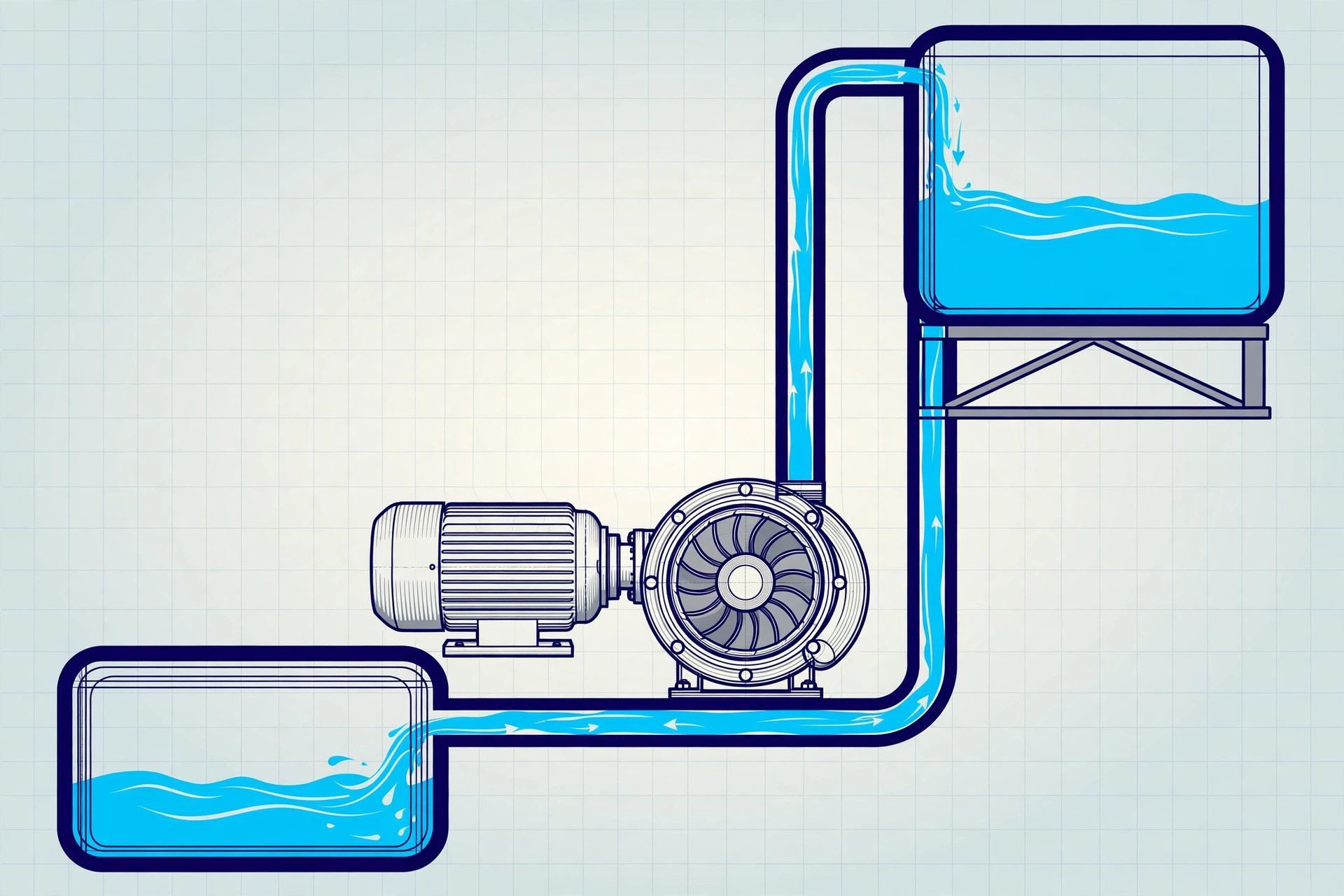
Lifting a liquid takes work, and the rate of doing that work is power. The hydraulic power a pump hands to the fluid is density times gravity times flow times head. Read it term by term: flow is how much liquid per second, head is the height each unit of liquid is effectively lifted, density converts volume to weight. The result is exact and assumption free: it is the power the fluid receives, whatever pump delivers it. Divide by the pump efficiency at the duty point and you have the shaft power the motor must provide. A flow of 10 litres per second lifted 20 metres in water receives just under 2 kW of hydraulic power, and at 75 percent efficiency calls for about 2.6 kW of shaft power.
Head is more than height
The head in the formula is total dynamic head, and beginners most often get the pump wrong by reading it as the physical lift alone. It includes the static lift between surface levels, the friction and fitting losses of the whole run at the duty flow, and any pressure difference between the vessels at each end. Friction head grows with the square of flow, so the system resists harder the faster you push, and the pump finds its own balance where its falling head curve meets the systems rising one. That crossing is the duty point, and both flow and efficiency belong to it. Specifying a pump means specifying the duty point, not a flow from one catalogue column and a head from another.
Efficiency, motors and margins
Pump efficiency peaks at one flow, the best efficiency point, and falls away on both sides. Running far right of it wastes power, overheats the pump and invites cavitation; far left, the liquid churns and heats. Choose the pump so the duty point sits near the peak, then size the motor for the shaft power at the duty point, or for end of curve power where the application can drift there, and take the next standard motor size up. Density is the quiet trap: the same pump on brine, oil or slurry lifts the same head in metres but demands power in proportion to density, and a motor sized on water figures can trip or burn on a heavier fluid. When in doubt, calculate with the densest fluid the pump will ever see.