The Reynolds Number Explained
A ratio of two tendencies
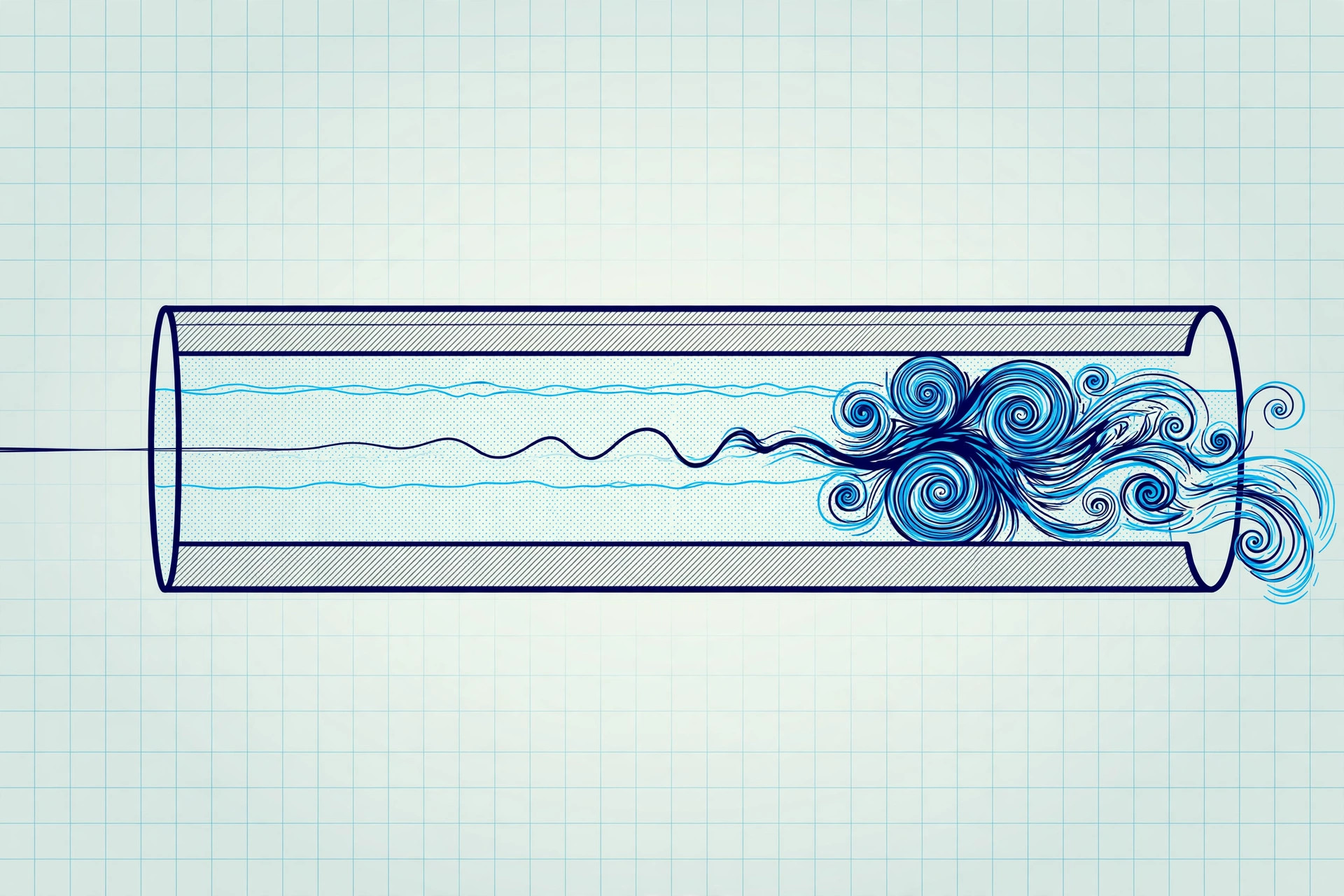
Every flowing fluid is pulled two ways. Its momentum wants to keep disturbances growing: a swirl in fast moving fluid feeds on itself. Its viscosity wants to smooth disturbances out, dragging layers back into line. The Reynolds number is the score of that contest: density times velocity times a characteristic length, divided by dynamic viscosity. Big and fast and runny gives a huge Reynolds number and chaos wins; small and slow and syrupy gives a low number and order wins. Because it is a pure ratio with no units, the same number describes the same behaviour in water, oil, air or steam, in a laboratory pipe or a river, which is what makes it the most useful single number in fluid mechanics.
The thresholds that matter
For flow in a round pipe the characteristic length is the diameter, and experience fixes the boundaries: below about 2300 the flow is laminar, orderly layers sliding over each other, and it stays laminar even if knocked, healing back. Above about 4000 it is turbulent, full of eddies, and will not settle. Between the two lies an uncertain transition where the flow can be either, depending on how carefully it was started. Other geometries use other lengths and have their own thresholds: flow over a flat plate turns turbulent near a Reynolds number of half a million based on distance from the leading edge. Engineers state the length they used with the number, because a Reynolds number without its definition is meaningless.
Why the number runs the subject
Almost every fluid correlation is plotted against Reynolds number. The friction factor of a pipe comes from the Moody chart, friction against Reynolds number with roughness as a parameter. Drag coefficients of spheres, cylinders and vehicles are functions of it. Heat transfer coefficients in pipes and over plates are correlated as powers of it. Two flows with the same Reynolds number and the same geometry are dynamically similar: pressures, drags and flow patterns scale predictably between them. That similarity is what makes wind tunnels and towing tanks honest: a model tested at the right Reynolds number tells the truth about the full size machine. When a fluid problem lands on your desk, computing the Reynolds number is the correct first move, because it tells you which regime, and therefore which formulas, you are allowed to use.