Series and Parallel Resistors
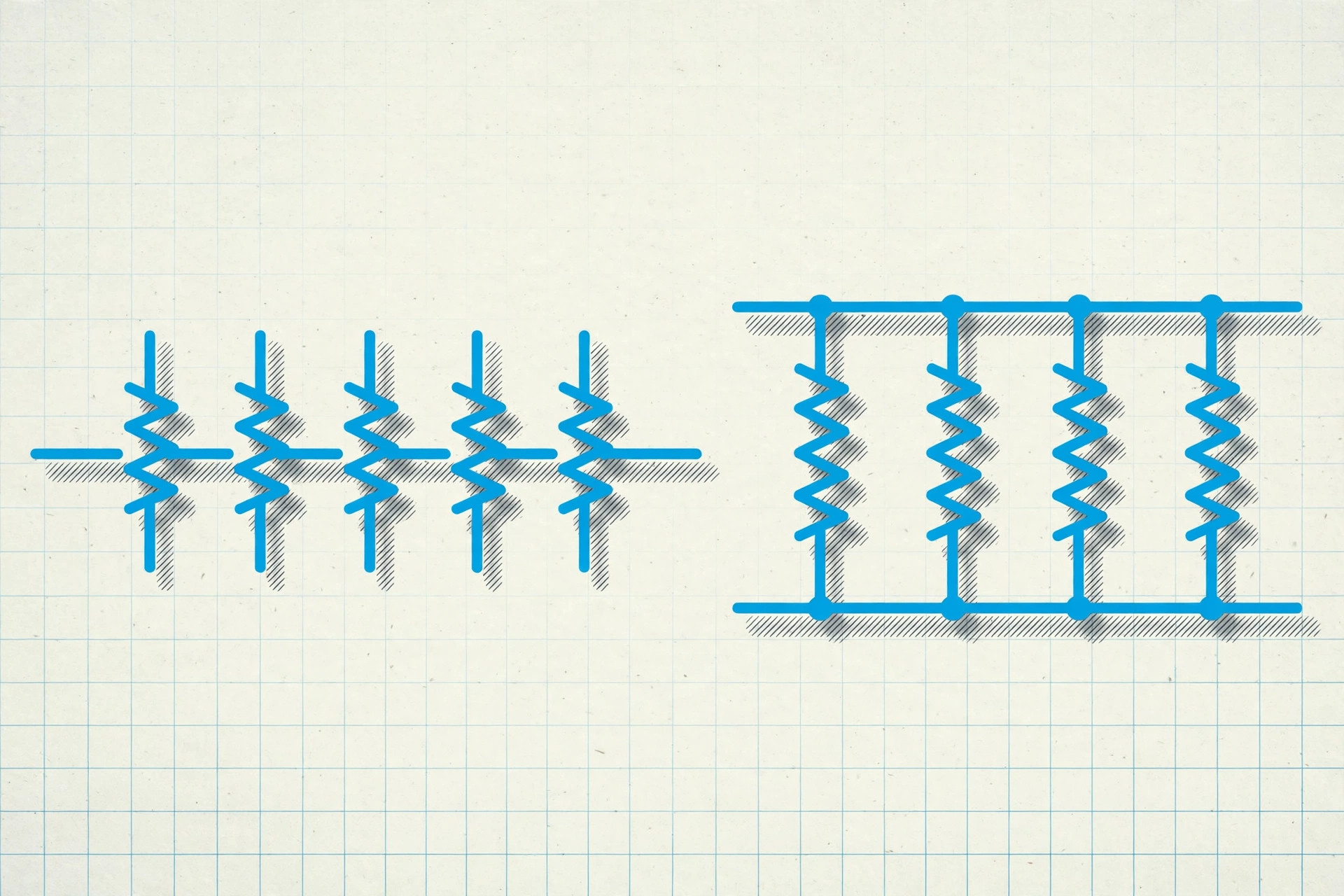
Series: one path, resistances add
Resistors in series share a single path, so the same current flows through each and the voltages across them add up to the supply. The total resistance is the plain sum. Ten ohms and twenty ohms in series behave as thirty, and the voltage divides between them in proportion to their values, the principle the voltage divider tool uses. Series connection is how you make a larger or non standard value from stock, share voltage between devices, and limit current: a resistor in series with an LED is doing exactly that. The power each resistor dissipates follows its share of the voltage, so in a series string the largest resistor works hardest and needs the largest wattage rating, a detail that matters when equal looking components are swapped.
Parallel: many paths, total falls
In parallel every resistor sees the full supply voltage, and the currents through the branches add. The total resistance is the reciprocal of the sum of reciprocals, which always lands below the smallest branch: ten and twenty ohms in parallel give 6.67 ohms, and adding a third resistor of any size lowers it further. Two equal resistors in parallel halve the value, a quick mental rule worth keeping. Current divides inversely with resistance, so the smallest resistor carries the most current and dissipates the most power, the mirror image of the series case. Parallel connection is the architecture of power distribution itself: every appliance in a house is in parallel across the supply, each taking its own current at the full voltage, independent of its neighbours.
Combinations and measurement traps
Real networks mix the two, and the method is always the same: collapse the innermost series or parallel group into its equivalent, redraw, and repeat until one resistance remains. Symmetry and identical values often simplify the arithmetic. When measuring in circuit, remember the meter sees the whole network, not the component: a resistor measured without disconnecting at least one end reads its value in parallel with everything connected to it, the classic cause of a good resistor reading low and being replaced in vain. And when paralleling to make a value, check the power: two resistors sharing a load share its dissipation, a legitimate way to build a high wattage resistor from smaller ones, provided the values are equal enough that the sharing is fair.