Shear Stress Explained
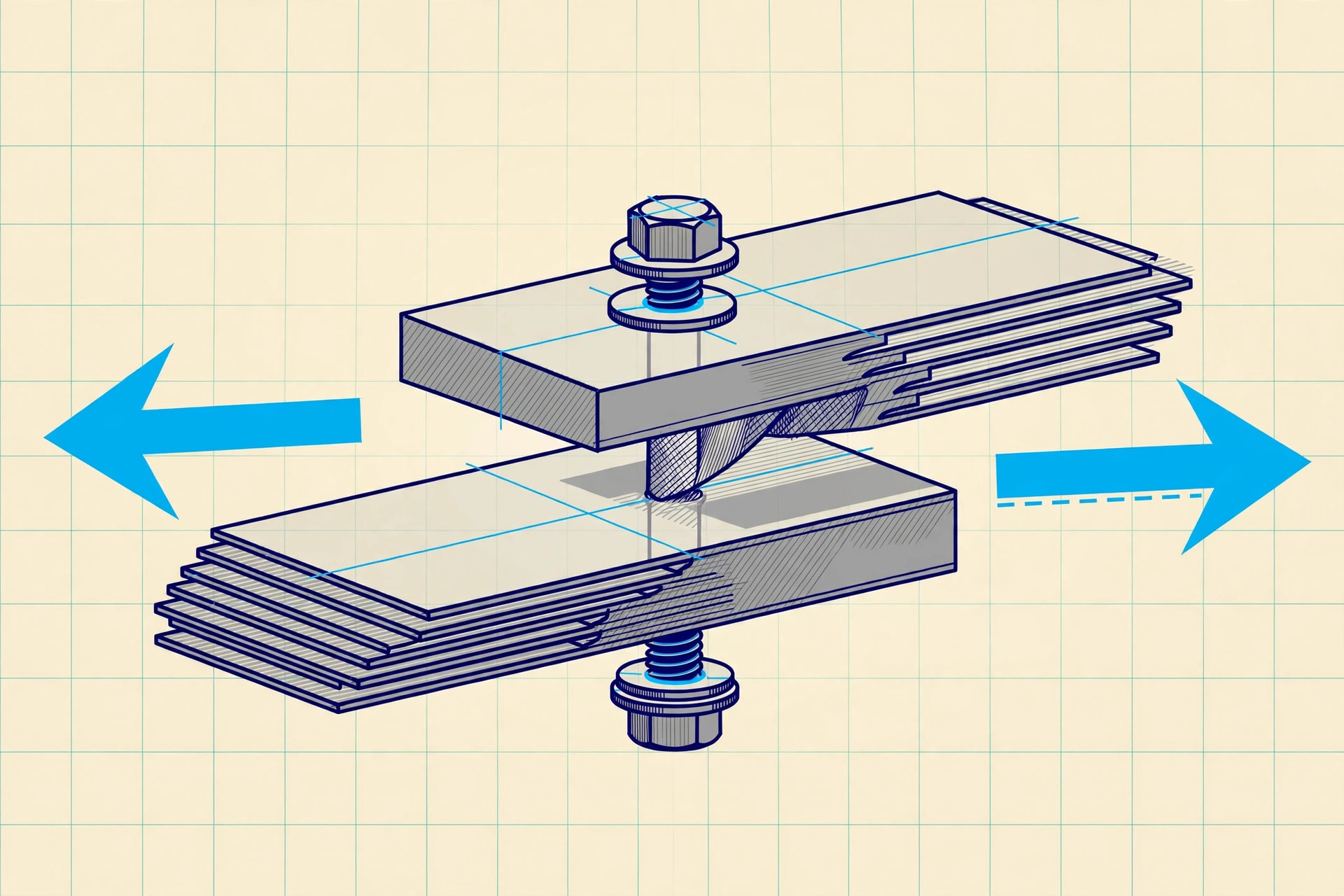
Force that slides rather than pulls
Tensile stress pulls material apart face to face; shear stress slides one layer of material across its neighbour, like pushing the top of a pack of cards. It appears wherever forces act parallel to a surface. A bolted joint loaded across the bolt puts the bolt shank in shear. A rivet, a pin, a key in a keyway and the weld throat of a fillet weld all work mainly in shear. Inside a beam, vertical shear force generates horizontal shear stress between the layers, which is why a beam made of stacked planks behaves so differently from a solid one unless the layers are glued or bolted together: without connection, the planks simply slide.
Shear in everyday calculations
The average shear stress is the shear force divided by the area resisting it, but the distribution is rarely uniform. In a beam the shear stress through the depth is parabolic, peaking at the neutral axis at one and a half times the average for a rectangle, and falling to zero at the top and bottom faces, exactly opposite to the bending stress pattern. In torsion the stress grows with radius instead. For pins and bolts the simple average is usually accepted, with the designer being careful about how many shear planes share the load: a bolt in double shear has two cross sections resisting, so each carries half the force. Forgetting a shear plane, in either direction, is a classic source of factor of two errors.
How strong is a material in shear?
For ductile metals the shear yield strength is a predictable fraction of the tensile yield: about 0.58 of it by the von Mises criterion, and design codes often work near 0.6. Shear failure in ductile materials is a sliding, yielding mode rather than a snapping one, which is why overloaded bolts bend and smear before they part. Brittle materials behave differently and can fail on diagonal planes, since shear at 45 degrees creates tension, which is why a piece of chalk twisted by hand breaks in a neat spiral. In timber, shear along the grain is a real weakness because the fibres separate easily. Always check which shear the code intends: average, peak, or an allowable already reduced by a safety factor.