Simply Supported vs Cantilever Beams
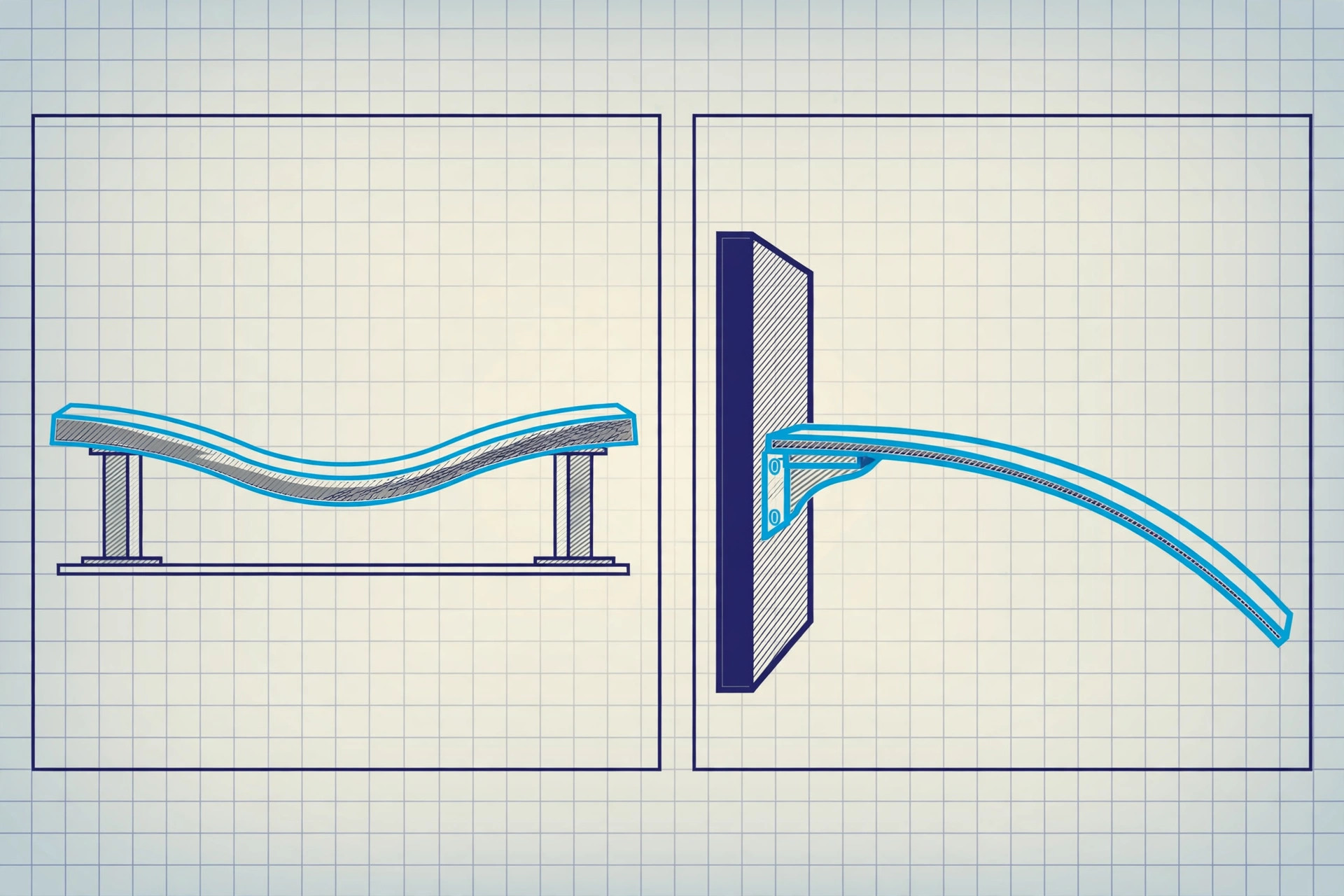
Two ways to hold a beam
A simply supported beam rests on supports at both ends and is free to rotate there, like a plank across two trestles. A cantilever is built in at one end and free at the other, like a diving board or a balcony. Everything else follows from that difference in restraint. The simply supported beam puts its maximum moment and deflection at midspan, spreads the load to two supports, and tolerates settlement and temperature movement gracefully because it can rotate at its ends. The cantilever concentrates everything at its root: the fixing must resist the full moment and shear, and any rotation or flexibility in the support shows up directly as extra movement at the tip.
The numbers compared
Take the same total load, span and section in both arrangements and the contrast is stark. A central point load on a simply supported beam gives a peak moment of P L over 4 and deflection of P L cubed over 48 E I. The same load at the tip of a cantilever gives a root moment of P L, four times as much, and a tip deflection of P L cubed over 3 E I, sixteen times as much. With a uniformly spread load the cantilever root moment is w L squared over 2 against w L squared over 8, again four times. This is why cantilever spans are kept short, why their sections are deepest at the root and often tapered, and why adding a prop to a cantilever, turning it into a propped arrangement, transforms its behaviour so dramatically.
Choosing between them
Simply supported spans are the default for floors, bridges and roof beams because they are efficient, forgiving and easy to erect: the beam is dropped onto its bearings and the job is done. Cantilevers are chosen when the space below must stay clear or the geometry demands an overhang: balconies, canopies, loading platforms, crane jibs and aircraft wings. Their design needs extra care in three places. The fixing or the back span must genuinely resist the root moment, including uplift on the far support of an overhanging beam. Deflection at the tip is usually the governing check, not strength. And the consequences of the single support failing are total, so redundancy and inspection matter more. When a calculation surprises you, check first which arrangement the formula assumes: using a simply supported formula for a cantilever understates the moment fourfold.
Put it into practice
The free calculator that goes with this guide:
Cantilever deflection calculator