Spring Rate Explained
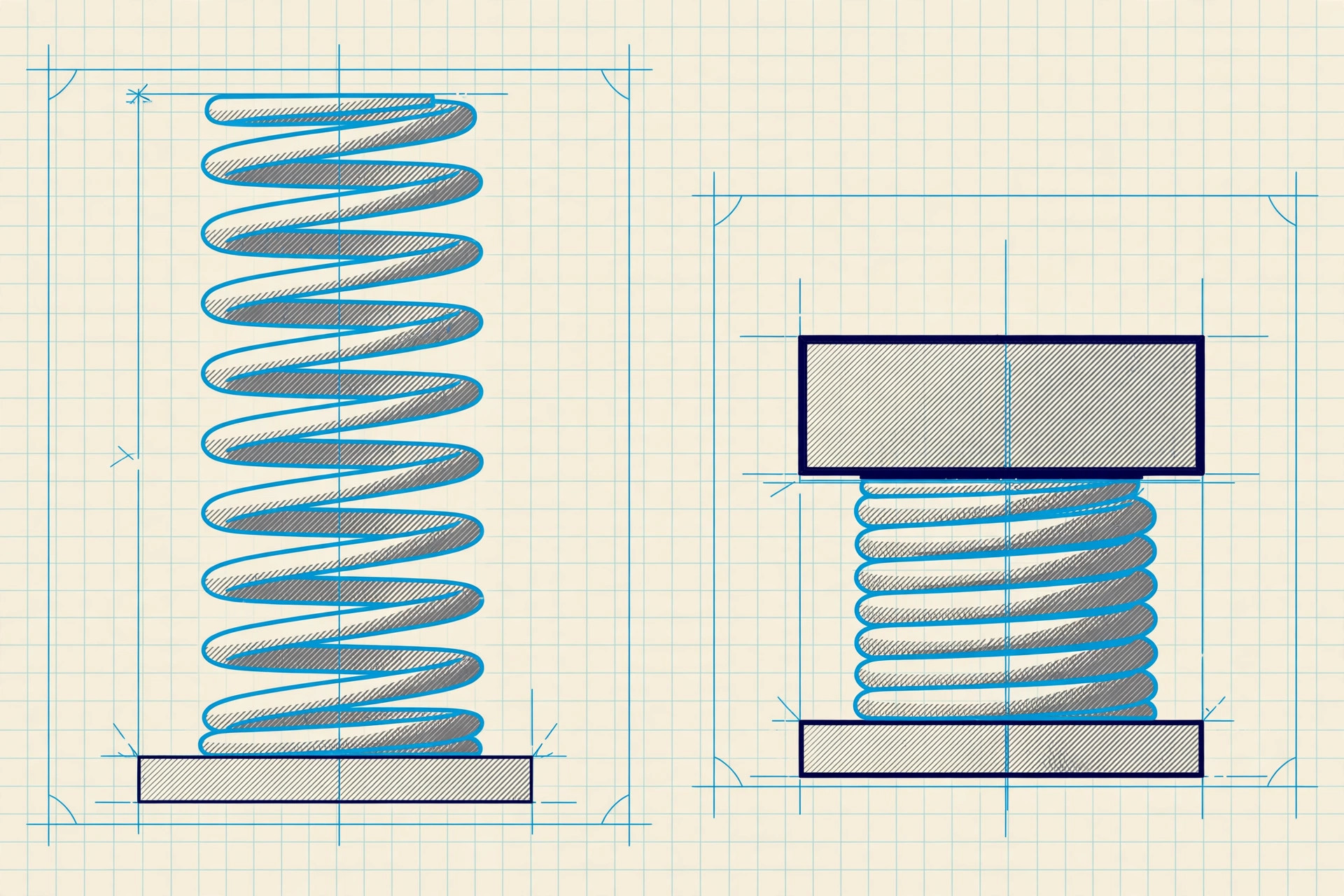
Rate: force per millimetre
A springs rate, also called its stiffness, is the force needed to deflect it by one unit of length: newtons per millimetre in metric workshops. A 12 N per mm spring compresses just over 8 mm under a 100 N load. Within its working range a coil spring is close to perfectly linear, which is what makes springs so useful in scales, valves, suspensions and return mechanisms: force and deflection track each other predictably. The rate stays constant until coils begin to touch at solid height, damage begins, or the spring takes a permanent set from being overstressed. Specifying a spring means specifying the rate, the free length, and the loads at the working heights, since rate alone does not fix how far it has already been compressed in the assembly.
The formula and its sensitivities
For a helical compression spring the rate is G times d to the fourth, divided by 8 times D cubed times the number of active coils, where d is wire diameter and D is mean coil diameter. The exponents are the whole story. Wire diameter enters to the fourth power: a 10 percent thicker wire makes the spring 46 percent stiffer, which is why springs are so sensitive to wire tolerance and why rust thinning a wire ruins its calibration. Coil diameter enters cubed, inversely: a bigger coil is a softer spring. Active coils enter plainly and inversely, so adding coils softens in direct proportion. G, the shear modulus of the wire, is about 79 GPa for spring steels and 42 for phosphor bronze, and barely varies between steel grades.
Choosing and checking a spring
Start from the job: the force needed at the working deflection sets the rate, and the space available sets rough limits on coil diameter and free length. Keep the spring index, mean diameter over wire diameter, between about 4 and 12: below that the wire is hard to coil and stresses soar, above that the spring tangles and buckles. Check the stress at maximum deflection, remembering the simple formula understates it and the Wahl correction factor, which grows as the index falls, should be applied for honest work. Check buckling for long slender springs, and surge, the springs own resonance, for fast cycling duty such as valve springs. Finally, leave margin to solid: a spring repeatedly slammed coil bound will fail early however good its stress figures look.