Stress and Strain: The Basics
Stress: force spread over area
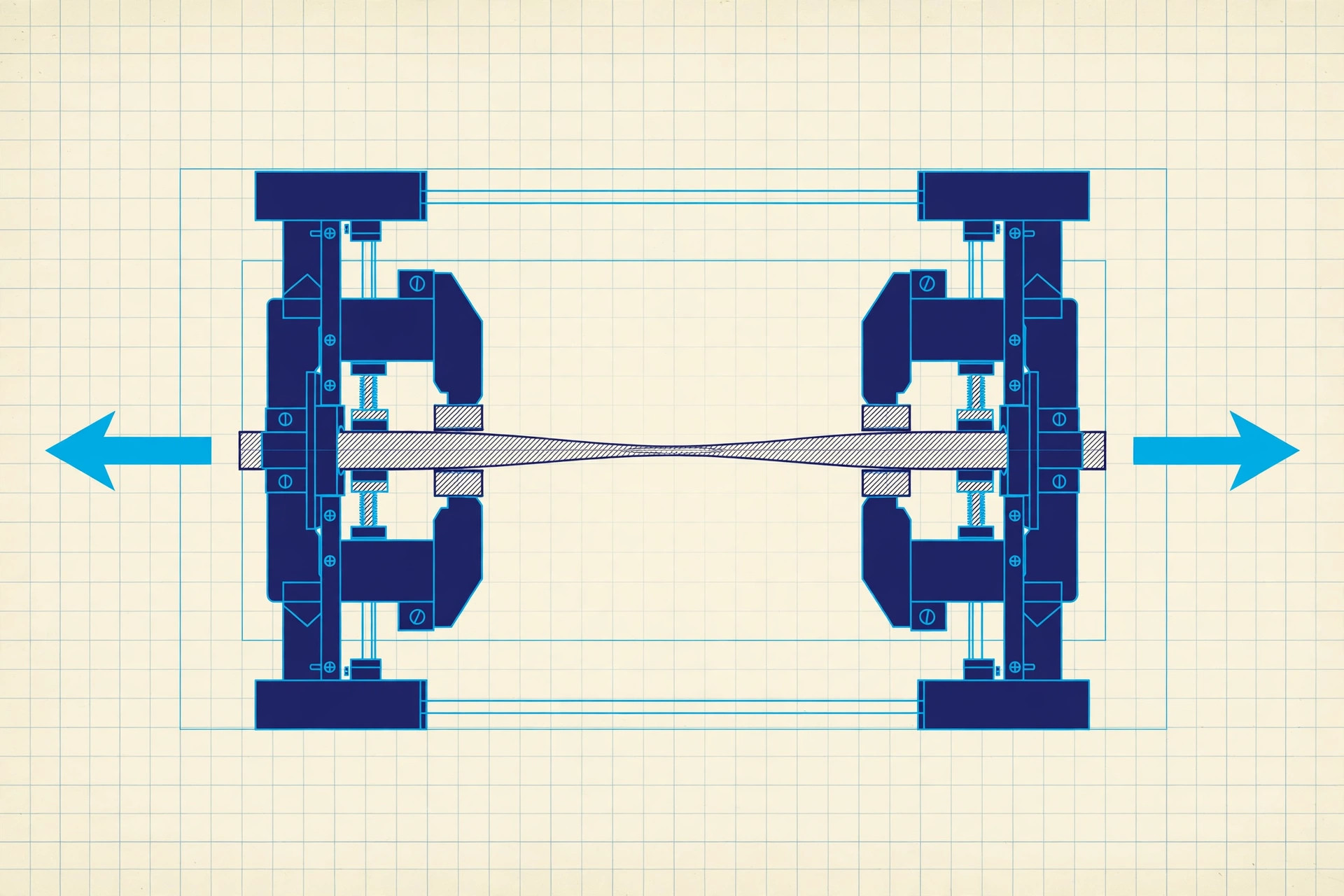
Stress answers the question: how hard is the material working at this point? It is simply the force divided by the area carrying it, measured in pascals, though engineers usually speak in megapascals, which are the same as newtons per square millimetre. A 10 kN tie bar sounds heavily loaded until you learn its cross section: on 100 square millimetres that is 100 MPa, a moderate stress for steel, while on 20 square millimetres it is 500 MPa, beyond the yield of ordinary grades. This is why force alone never tells you whether something is safe. Stress comes in flavours: tensile pulling apart, compressive pushing together, and shear sliding one layer over another. Most real parts see a mixture, but the simple axial case is where every engineer starts.
Strain: stretch per unit length
Strain measures how much the material deforms, expressed as the change in length divided by the original length. It has no units, and in metals it is tiny: a steel bar stressed to 200 MPa strains by one part in a thousand, stretching one millimetre over a metre. Engineers often quote strain in millimetres per metre or in microstrain to keep the numbers friendly. Strain is what instruments actually measure. A strain gauge glued to a part changes its electrical resistance as it stretches with the surface, letting engineers read real stresses in bridges, pressure vessels and machine parts. When a tensile test stretches a specimen, the machine records strain continuously while load gives stress, producing the stress strain curve that defines the materials behaviour.
Hookes law ties them together
For most metals at working loads, stress is directly proportional to strain: double the stress, double the stretch. This is Hookes law, and the constant of proportionality is Youngs modulus, E. The relationship holds only up to the proportional limit, close to the yield point. Beyond yield the material deforms permanently, strain grows fast with little extra stress, and the simple law no longer applies. Almost all routine machine and structural calculation lives deliberately inside the elastic region, where Hookes law makes behaviour predictable and reversible: load the part, it stretches; unload it, it returns exactly to shape. Elongation follows directly: strain times original length. That one line lets you predict how much a tie rod, a bolt or a lift cable will stretch under load, which matters for alignment, preload and fit.