Stress Concentration Explained
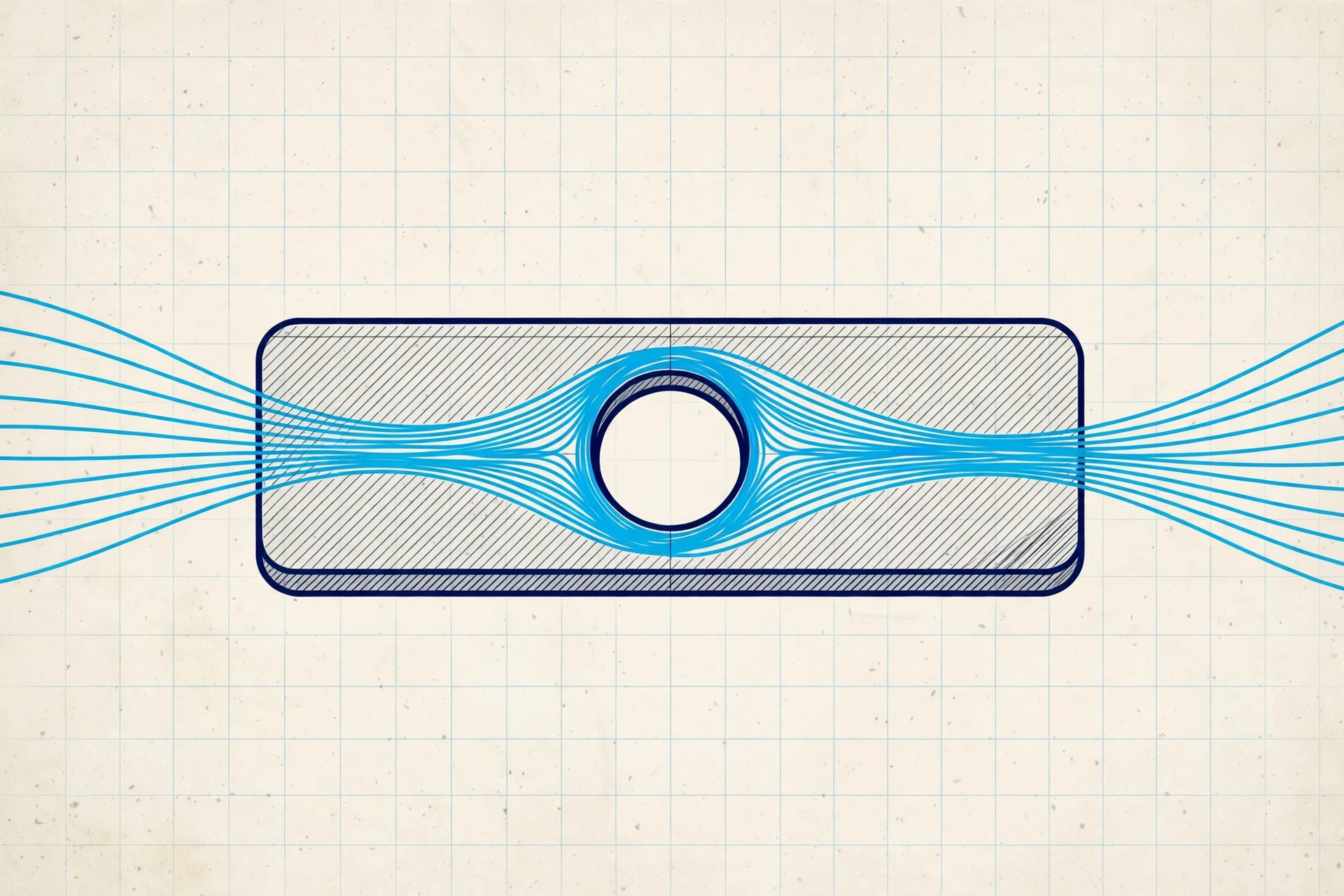
Stress flows like a fluid
A useful picture of stress inside a loaded part is of lines of force flowing through the material, evenly spaced in a uniform bar. Where the section changes, the flow must squeeze around the obstacle. Drill a hole in a tension bar and the flow lines crowd around the hole edges, so the local stress there reaches about three times the average stress based on the net section. Put a sharp notch in the part and the crowding is worse; in the limit of a perfectly sharp crack the elastic theory predicts infinite stress, which is why cracks are treated with such respect. The ratio of peak local stress to nominal stress is the stress concentration factor, K, read from charts against geometry ratios for each standard case.
Where concentrations hide
The usual suspects are holes, fillets where a shaft changes diameter, keyways, thread roots, circlip grooves, weld toes and sudden changes in thickness. Threads are a good example: the root of a standard thread has a concentration factor of around 3 or more, which is why bolts fatigue at the first engaged thread. Fillets show how much geometry matters: increasing a shoulder fillet radius from a token 0.5 mm to a generous 3 mm can cut the factor from above 2.5 to near 1.3. Welded joints deserve special suspicion because the weld toe combines a geometric notch with residual stress and possible defects, which is why fatigue classes for welded details are so much lower than for plain plate.
Using the factor honestly
Whether the peak stress matters depends on the loading and the material. For a ductile material under a single static load, the peak yields locally, redistributes, and the part usually survives: static design often ignores K for ductile metals, though not for brittle ones like cast iron or hardened steel, which cannot yield to soften the peak. Under repeated load there is no such mercy, and fatigue design applies the concentration factor, or its slightly kinder cousin the fatigue notch factor, in full. Practical defences are simple: radius every internal corner you can, keep holes away from edges and high stress zones, avoid abrupt section changes, and never put a weld toe, a stamp mark or a centre punch in the most stressed fibre of a cyclically loaded part.