Thermal Expansion Explained
Everything moves with temperature
Heat a bar and it lengthens; cool it and it shrinks. The change is proportional to the original length and to the temperature change, with the proportionality set by the materials coefficient of linear expansion, quoted in micro metres per metre per degree. Steel and concrete both sit near 12, a fortunate match that makes reinforced concrete possible: the two materials move together as temperature swings, so the bond between them is not torn apart. Aluminium moves about twice as much at 23, copper about 17, brass 19, and plastics far more, PVC around 80. A 10 metre steel beam through a 50 degree swing grows 6 mm: small, but far more than enough to crack masonry, bow a restrained pipe, or open a roof joint.
When movement is prevented
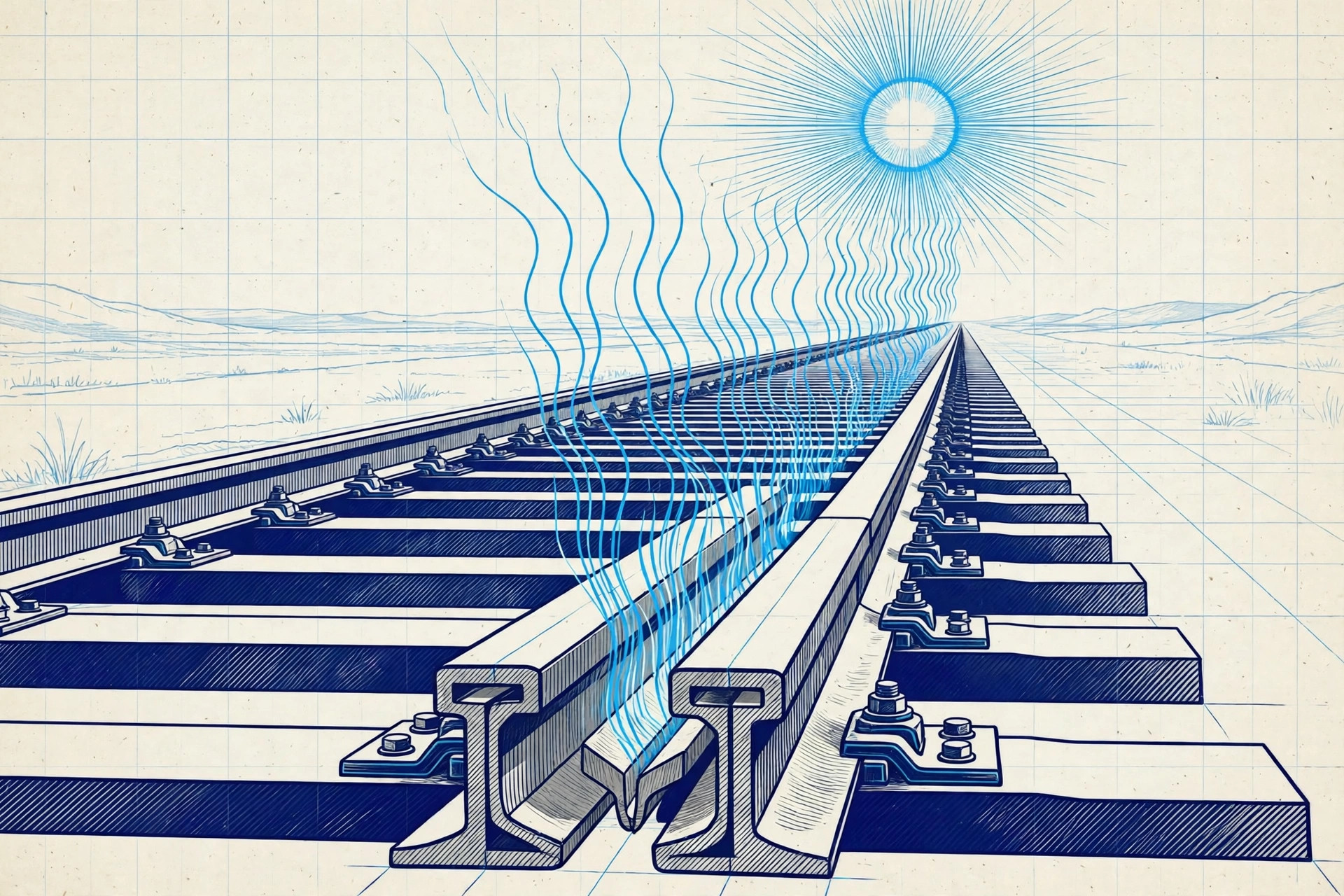
Free expansion is harmless. Restrained expansion is a force generator. If a bar is clamped at both ends and heated, the expansion that cannot happen converts into compressive stress of E times the coefficient times the temperature change: for steel heated 50 degrees, about 120 MPa, from temperature alone, before any working load. Long pipelines handle this with expansion loops and bellows that flex to absorb the growth; railways manage it with gaps in jointed track or by deliberately prestressing continuously welded rail; bridges sit on bearings and end at expansion joints you can see and hear. The design question is never whether the material will move, but where the movement will go. Every long run of anything needs an answer to that question.
Designing for movement
The working rules are simple to state. Calculate the movement with the expansion formula over the full temperature range the part will see, installation temperature to both extremes, not just the operating temperature: a pipe installed on a freezing morning and steamed in service sees the whole span. Provide for that movement with loops, bellows, sliding supports or flexible connections, sized with margin, and anchor and guide the run so the movement goes where the flexible elements are. Watch bimetallic pairs: bolting aluminium to steel, or cladding a steel frame in a dissimilar skin, builds in differential movement at every fixing, which slotted holes and flexible seals exist to absorb. Finally, remember instruments and fits: a precision shaft and its housing in different materials can gain or lose their interference as temperature changes, a fact machine designers ignore at the cost of seized or slack assemblies.