Thread Sizes and Tap Drills
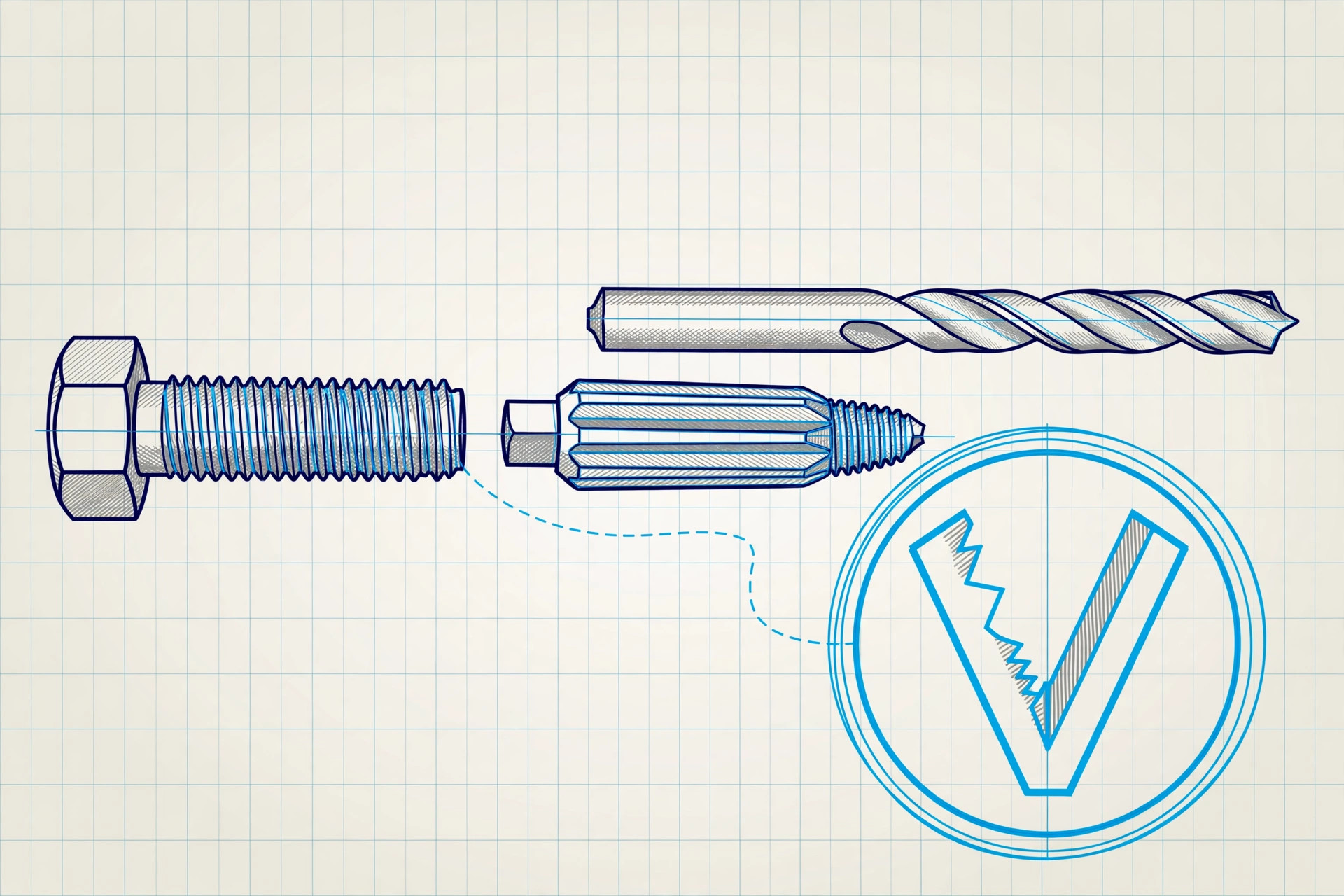
Reading a thread callout
A callout such as M10 by 1.5 names a metric ISO thread of 10 mm nominal diameter and 1.5 mm pitch, the pitch being the distance from one thread crest to the next, and also the distance the screw advances in one full turn. Each diameter has a standard coarse pitch, the default when only the diameter is given: M6 takes 1.0, M8 takes 1.25, M10 takes 1.5, M12 takes 1.75 and M20 takes 2.5. Fine pitches exist for thin walls, adjustment and vibration resistance. The thread is a 60 degree V profile, and the standard proportions fix everything else: the depth of the basic thread is about 0.54 times the pitch, which is what makes the tap drill rule work.
The tap drill rule and why it works
Before tapping, the hole is drilled to the minor diameter the tap needs, and for metric threads the workshop rule is tap drill equals nominal diameter minus pitch. M10 by 1.5 therefore wants an 8.5 mm drill, a size stocked precisely because this rule is used so often. The rule gives about 75 percent thread engagement, and that is a deliberate compromise: engagement beyond 75 percent adds almost no strength, because the bolt will break in tension before the threads strip, yet demands sharply more tapping torque and breaks more taps. In hard materials or deep blind holes, dropping to 60 or 65 percent engagement with a slightly larger drill is legitimate practice. In soft materials like aluminium, more engagement and a longer thread length are worthwhile instead.
Clearance, countersinks and mistakes
The bolt also needs a hole to pass through in the mating part. Close clearance for an M10 bolt is about 10.5 mm, normal clearance 11, free clearance 12, chosen by how accurately the parts locate. A small countersink or chamfer on both the tapped hole and the clearance hole is not decoration: it removes the raised burr that would otherwise hold the joint faces apart and steal preload. The common failures are predictable: drilling the tap hole at full diameter so the tap cuts air, using the clearance drill for the tap hole, forgetting that a blind hole needs extra depth for the taps tapered lead and the drill point, and tapping dry in aluminium, which tears. Drill sizes, like the rule behind them, reward being checked before the metal is cut.