Torque, Speed and Power: The Relationship
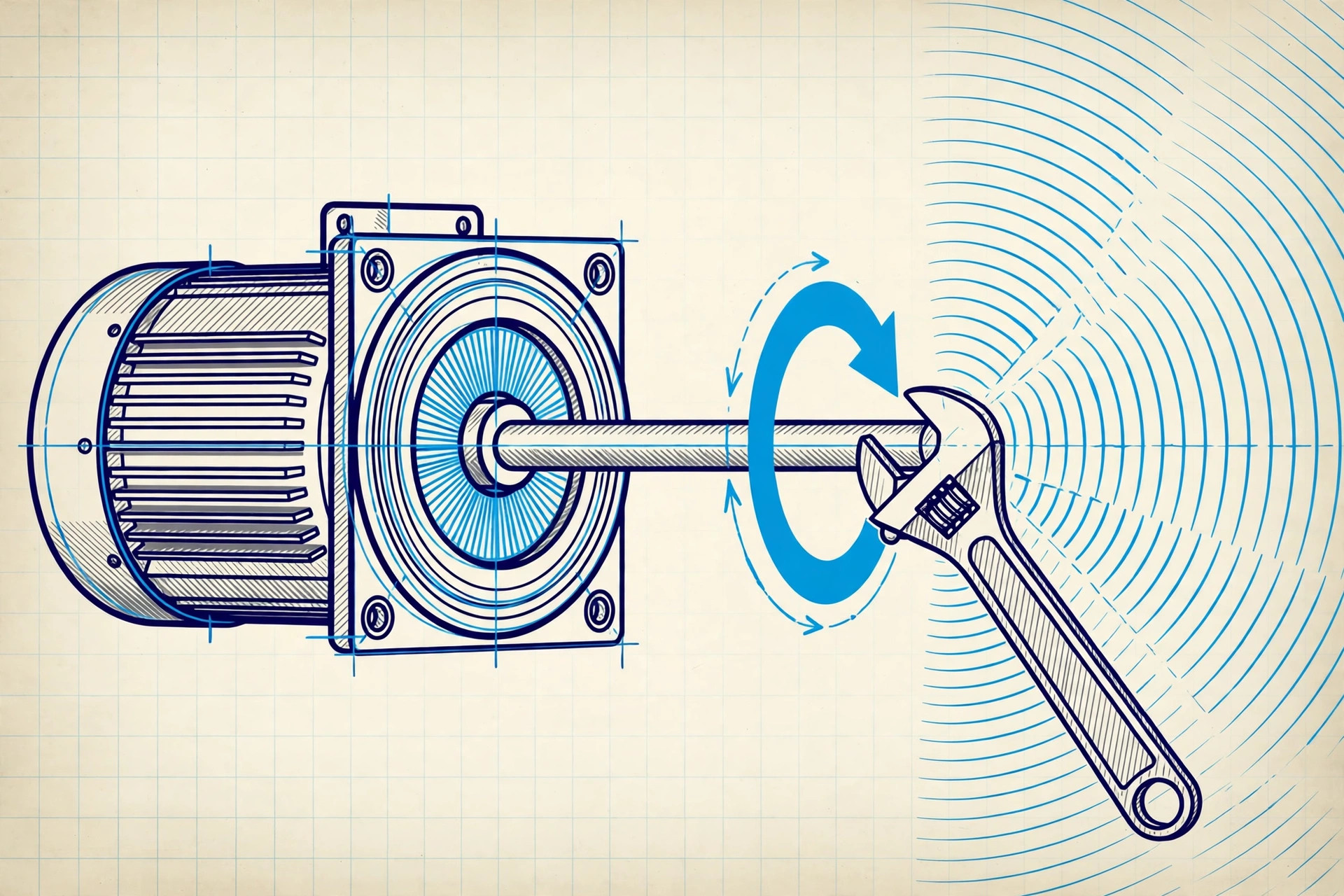
One equation, three quantities
Every rotating machine, from a cordless drill to a ship propeller, obeys the same relationship: power equals torque times angular velocity. In the units engineers actually use, power in kilowatts equals torque in newton metres times speed in rpm, divided by 9550. That constant is just 60 over 2 pi dressed in kilowatts, and the torque power calculator uses exactly this. The equation means torque and speed trade against each other for a given power. A 10 kW motor at 1500 rpm produces about 64 Nm; gear it down to 150 rpm and the same power arrives as roughly 640 Nm, minus losses. This trade is the entire reason gearboxes exist.
Why nameplate power is not torque
A common confusion is to treat a motors kilowatt rating as if it were a torque. The rating only becomes torque at a stated speed. Two motors of identical power can have wildly different torques if their speeds differ: a high speed 3000 rpm motor has half the torque of a 1500 rpm motor of the same power, and a quarter that of a 750 rpm machine. When a driven load needs a certain torque at a certain speed, the required power follows immediately, and that is how motors are first sized. It also explains why a car engine advertised on power still needs a gearbox with many ratios: at low wheel speed the torque demand is high, and the gearbox performs the exchange.
Losses and the honest number
The equation gives the power crossing the shaft at the point you measure. Between the motor terminals and the load, each element takes its cut: a gear mesh a percent or two, a belt drive two or three, a worm gear far more, sometimes a third of the input. Bearings, seals and churning oil add their own small tolls. When you work backwards from a load to choose a motor, apply the efficiencies in sequence and round up to the next standard motor size. When you measure a running machine, remember which side of the gearbox your torque figure belongs to. Mixing input torque with output speed is the classic way to invent free energy on paper, and the equation, applied consistently at one shaft, is the guard against it.