U Values and Heat Loss Explained
One number for a whole wall
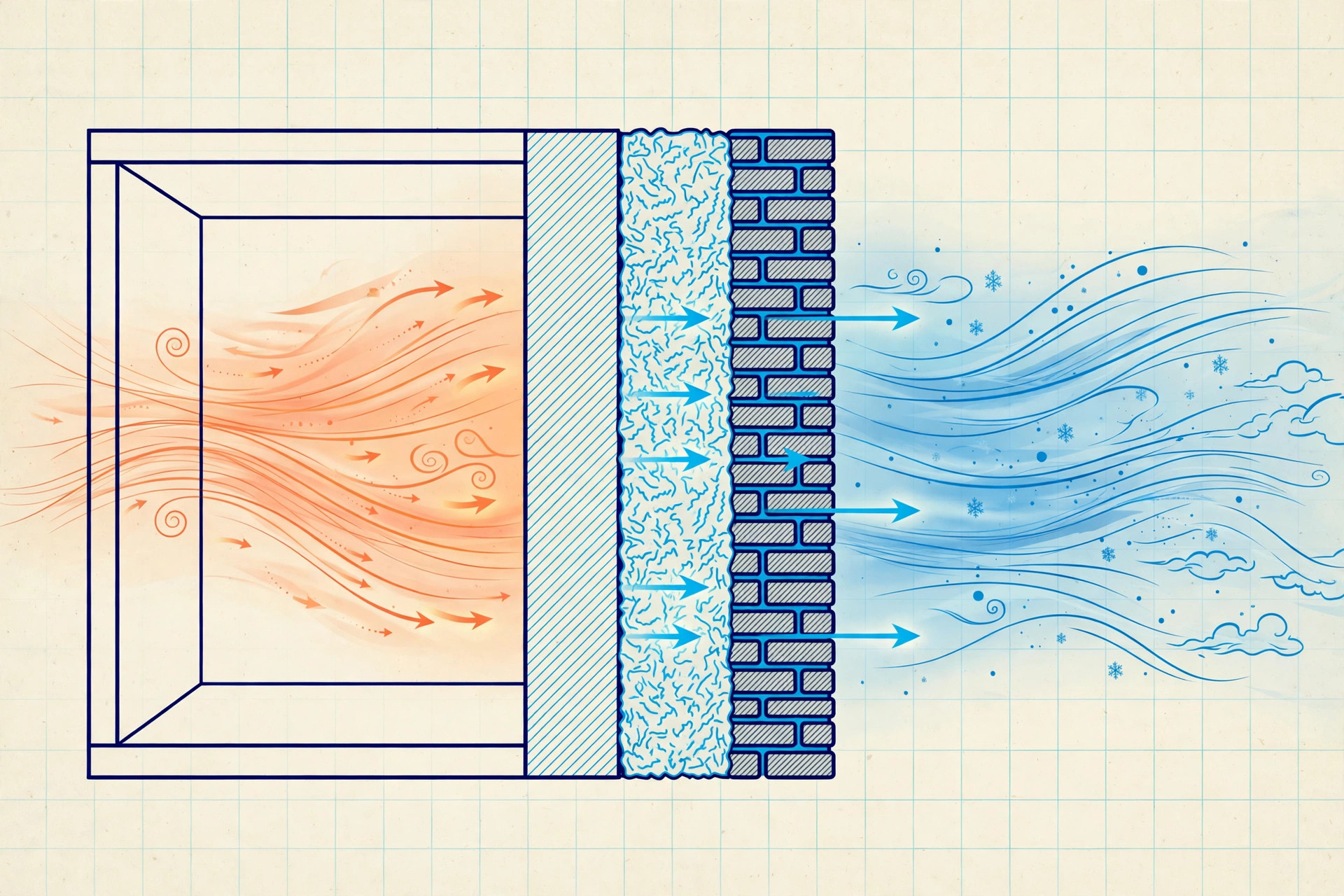
The U value measures how readily heat passes through a construction: watts of heat flow per square metre, per degree of temperature difference between inside and outside. Low is good. A bare single glazed window sits near 5, an uninsulated cavity wall near 1.5, and a modern insulated wall near 0.2 or better. Because the U value folds every layer and both surface films into one figure, it lets designers compare constructions, size heating plant, and prove compliance with building regulations, which set maximum U values element by element. Multiply U by area and by temperature difference and you have the heat loss in watts through that element, the arithmetic at the heart of every heating calculation.
Building the number from layers
Heat crossing a wall passes through resistances in series: the inside surface film, each material layer, and the outside film. Each layer contributes its thickness divided by its thermal conductivity, its R value, and the resistances simply add. Standard surface resistances are 0.13 inside and 0.04 outside in square metre kelvins per watt. Conductivity is where the materials part company: dense concrete conducts at about 1.4, brick at 0.7, timber at 0.13, and insulation materials at 0.022 to 0.04, thirty times better than brick thickness for thickness. This is why 50 mm of foam outperforms half a metre of brickwork, and why the insulation layer, though thinnest, usually contributes most of the total resistance. The U value is one divided by the total resistance.
Where the simple sum misleads
The layered sum assumes heat flows straight through in one dimension. Real walls have bridges: timber studs, wall ties, lintels and slab edges that conduct better than the insulation they interrupt, short circuiting it. A stud wall calculated naively can understate its true U value by a third once the timber fraction is counted, and metal framed constructions fare worse. Air gaps help only when still and narrow; a wide ventilated cavity contributes almost nothing beyond its surfaces. Moisture raises conductivity, so wet insulation underperforms its datasheet. Good practice applies the bridged calculation methods of the standards, details junctions carefully, and treats the headline U value as a property of the whole built element, not of the insulation product alone.