Viscosity Explained
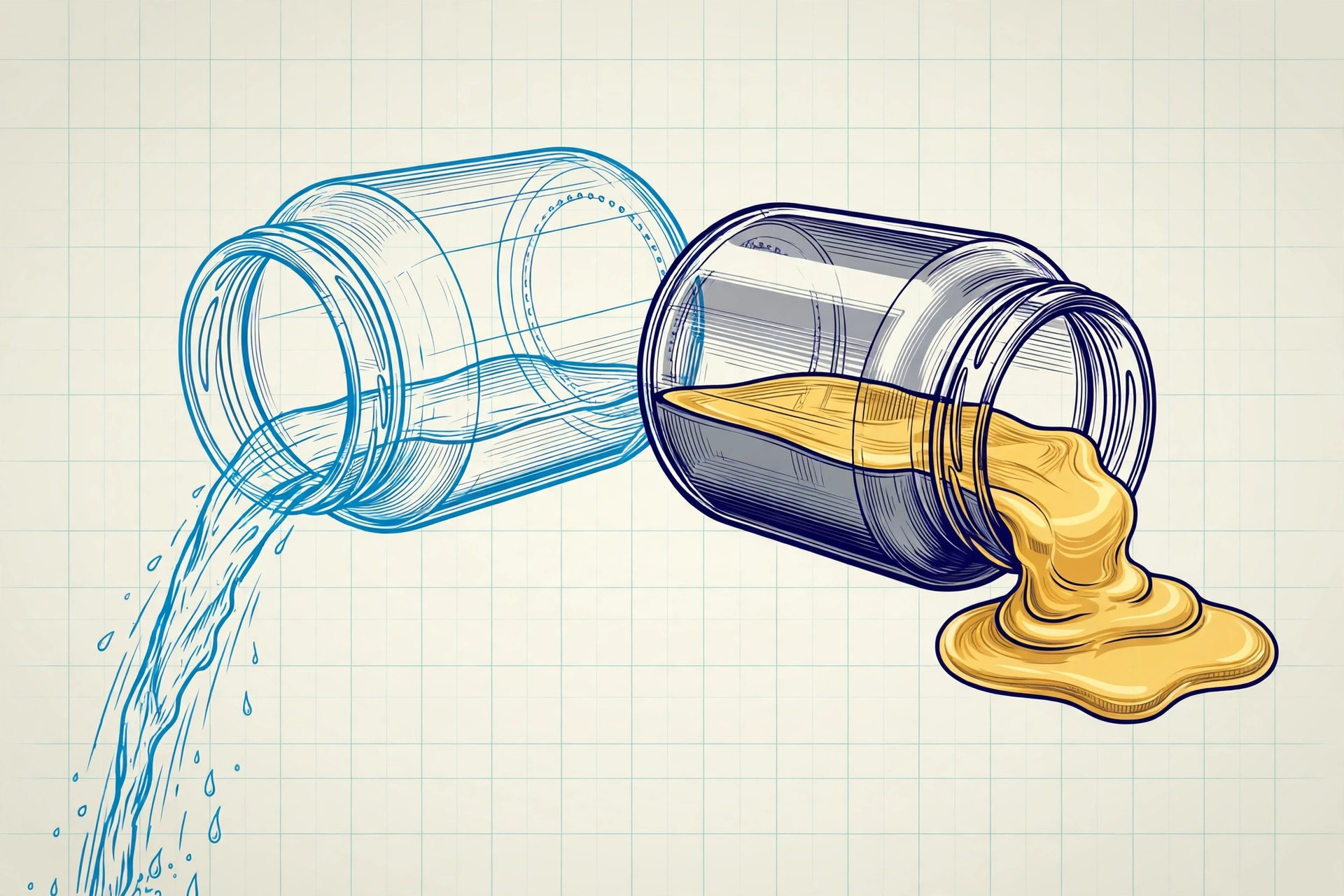
The internal friction of a fluid
Viscosity is a fluids resistance to being sheared: its internal friction. Pour honey and water side by side and the difference needs no instrument. At the molecular level, viscosity is momentum being dragged between layers moving at different speeds. It sets how hard a fluid is to pump, how thick a lubricating film will be, how fast particles settle, and whether flow runs laminar or turbulent. In the Reynolds number it stands on the smoothing side of the contest, which is why a very viscous fluid can move fast in absolute terms yet stay stubbornly laminar: it is the ratio that decides, not the speed alone.
Two viscosities, two unit systems
Dynamic viscosity, the one in the Reynolds formula, is measured in pascal seconds. Water at 20 degrees C is almost exactly 0.001 Pa s, one millipascal second, a handy anchor. Kinematic viscosity divides the dynamic value by density and is measured in square millimetres per second, the unit in which oils are sold: a ISO VG 46 hydraulic oil has a kinematic viscosity of 46 mm2/s at 40 degrees C. Confusing the two is a classic error, off by a factor of the density. Temperature dominates everything: oils thin dramatically as they warm, roughly halving in viscosity for every 15 to 20 degrees, and water falls from 1.8 mPa s near freezing to 0.28 at boiling. Gases do the opposite, thickening slightly as they heat, because their viscosity comes from molecular darting rather than cohesion.
Viscosity at work
Lubrication is viscositys home ground: the oil film that keeps a bearing apart exists because the oil is viscous enough to be dragged into the converging gap and generate pressure. Too thin and the film collapses into metal contact; too thick and churning wastes power and the oil cannot reach tight clearances when cold. Pumping viscous fluids is the other everyday encounter: in laminar flow the pressure drop is directly proportional to viscosity, so a cold start on a winter morning can demand several times the running pressure, and relief valves and motor overloads must be set with the cold figure, not the warm one. Paint, food, adhesives and polymer melts all have viscosity that changes with shear rate as well, the non Newtonian world, where a single viscosity number is only the start of the description.