What Is Bending Stress?
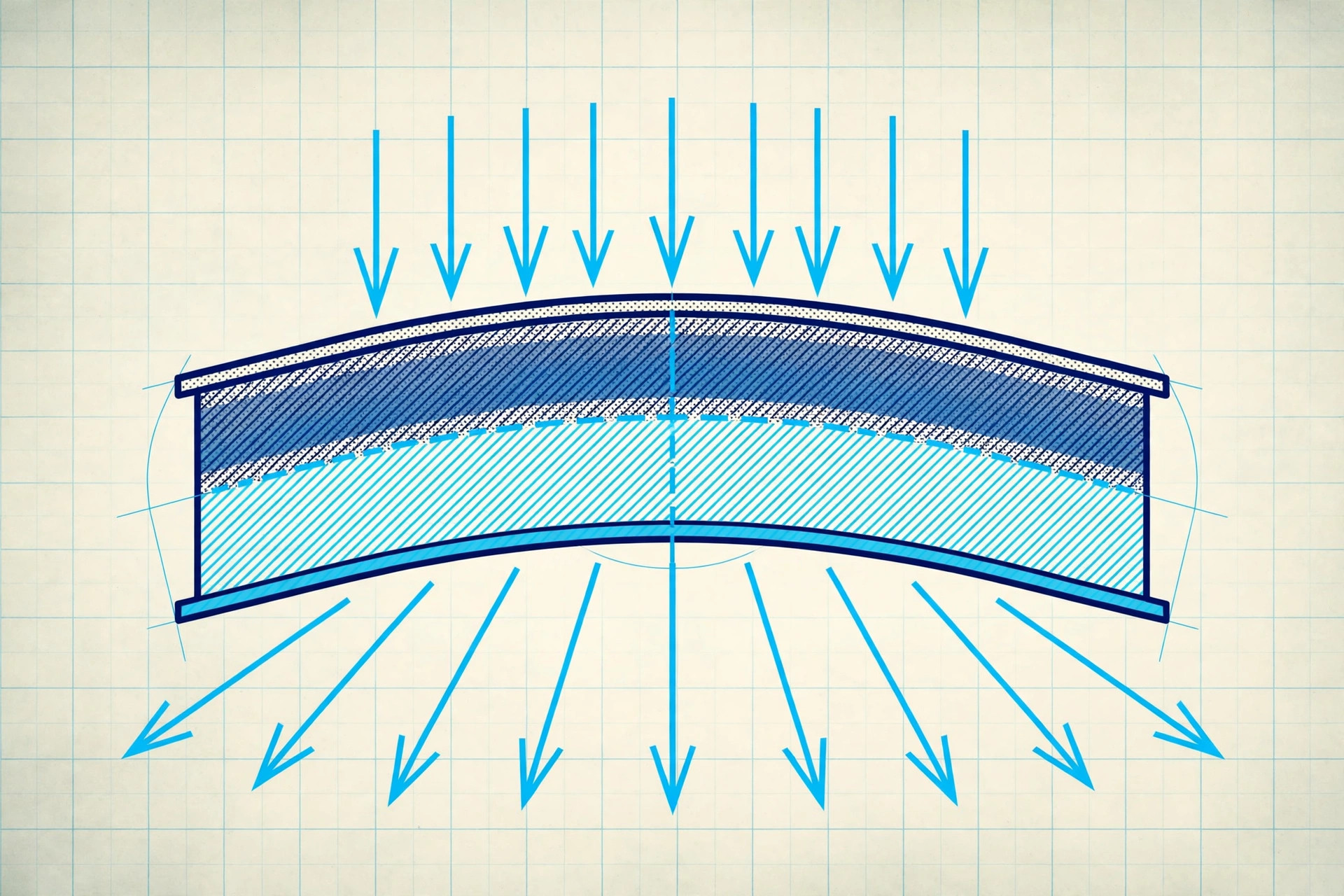
Tension below, compression above
Bend a ruler and watch its faces: the outside of the curve stretches, the inside squeezes. A loaded beam behaves the same way. For a beam sagging under a downward load, the bottom fibres are pulled in tension and the top fibres are pushed in compression. Somewhere between them lies a surface that neither stretches nor shortens, the neutral axis, which passes through the centroid of the cross section. Stress grows in direct proportion to distance from that axis, so the highest stresses in the whole beam live at the extreme top and bottom fibres. That is why I beams put most of their material in the flanges, far from the neutral axis, and very little in the web near it. Material near the middle of the depth contributes little to bending strength.
The bending formula
The stress at the outer fibre is the bending moment divided by the section modulus, written sigma equals M over Z. The section modulus is the second moment of area divided by the distance from the neutral axis to the outer fibre, and section tables list it directly for standard shapes. The formula rests on a few assumptions worth knowing: the material is elastic, stress stays proportional to strain, and the cross section is symmetric about the bending axis. It gives the peak stress at the section where the moment is greatest, usually midspan for simple loads. Shear stress, by contrast, peaks at the neutral axis, and in most beams it is small compared with bending stress, though short deep beams and timber beams are exceptions that need the check.
Comparing stress with strength
A stress number means little until it is set against what the material can carry. Divide the calculated stress by the allowable stress for the grade and you get the utilisation: 60 percent means a comfortable margin, 98 percent means the section is working almost at its limit. Allowable values come from the design code for the material and already contain safety factors, or are derived from the yield strength divided by a chosen factor. Remember that bending stress is only one check among several. The same beam must also pass shear, deflection, bearing at the supports and, for slender compression flanges, lateral torsional buckling. Passing the bending check with room to spare while ignoring deflection is one of the most common beginner mistakes in beam design.