Youngs Modulus Explained
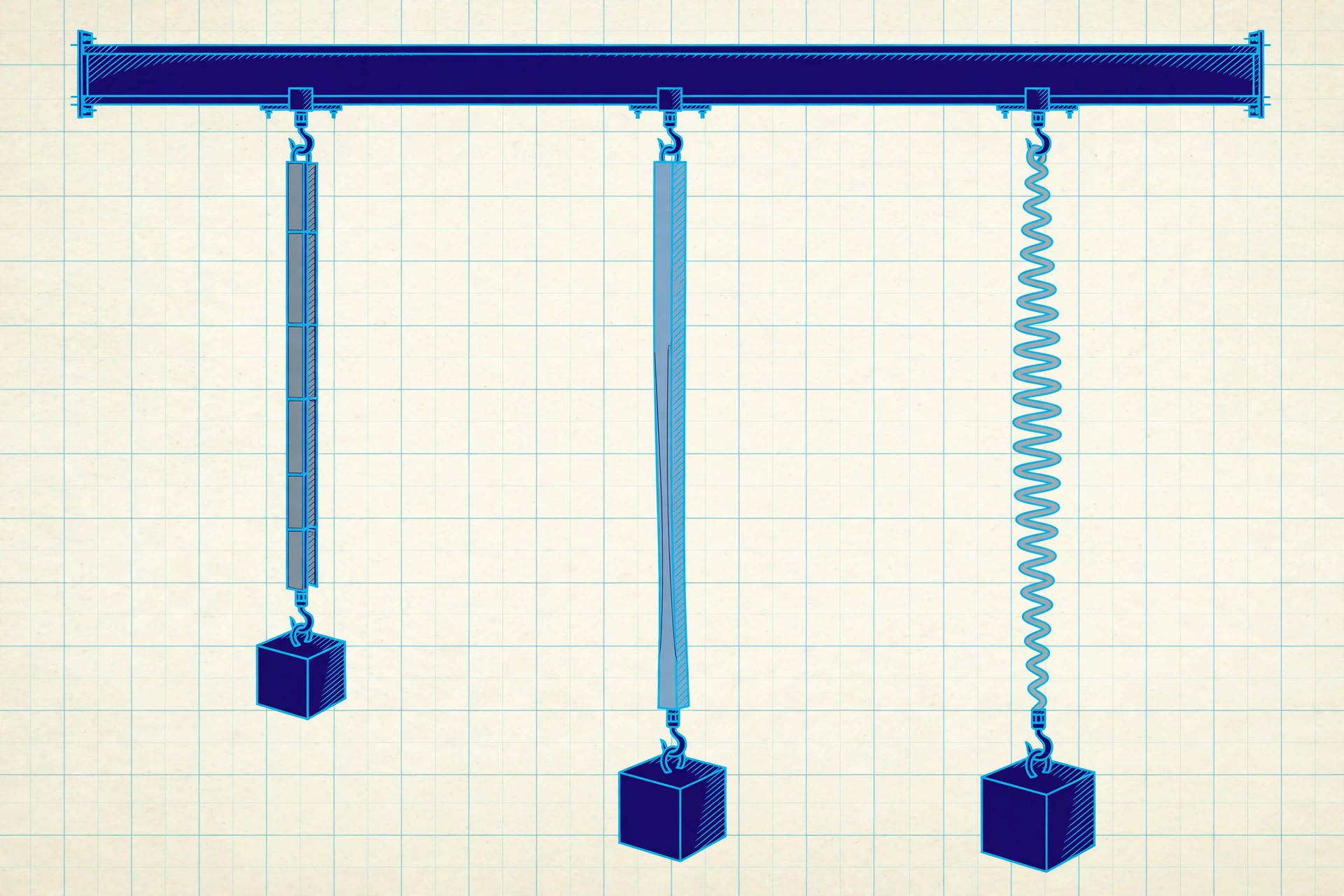
A measure of stiffness, not strength
Youngs modulus, written E, describes how stiff a material is: how much it stretches under a given stress while still behaving elastically. It is the slope of the straight part of the stress strain curve. Confusing stiffness with strength is a classic error. A high carbon steel and a mild steel have almost identical Youngs modulus, near 200 GPa, yet very different yield strengths. Swap one for the other in a beam and the strength changes a lot, but the deflection barely changes at all. Rubber sits at the other extreme, with E measured in thousandths of a GPa, while diamond tops the table near 1000 GPa. When a design is governed by deflection, vibration or buckling rather than by breaking, E is the property that matters most.
The numbers for common materials
Steel of any ordinary grade: about 200 GPa. Stainless steel: about 193. Aluminium alloys: about 69, almost exactly a third of steel, which is why an aluminium part needs roughly three times the second moment of area to match a steel parts stiffness, though it then weighs about the same. Copper: about 117. Cast iron: 100 to 170 depending on grade, since its graphite flakes soften it. Timber is the awkward one: E runs from about 8 to 14 GPa along the grain depending on species and grade, and moisture moves it further, while across the grain it is far lower. Concrete sits around 25 to 35 GPa and creeps under sustained load, effectively softening with time. Glass is about 70, similar to aluminium.
Why it barely changes
Youngs modulus is set by the bonds between atoms, so alloying, heat treatment and cold work, which transform strength, move E by only a few percent. You cannot order a stiffer steel; you can only order a stronger one. Temperature does soften it: steel loses roughly 10 percent of its stiffness by 300 degrees C and much more in a fire, which is one reason structural fire protection matters. For the designer the lesson is blunt. If a part deflects too much, changing to a fancier grade of the same metal will not help. The answers are geometric: deepen the section, shorten the span, add a support, or move to a genuinely stiffer material. That is why stiffness problems are usually solved on the drawing, not in the materials catalogue.